
 Español
 Nederlands
 Chinese Mandarin
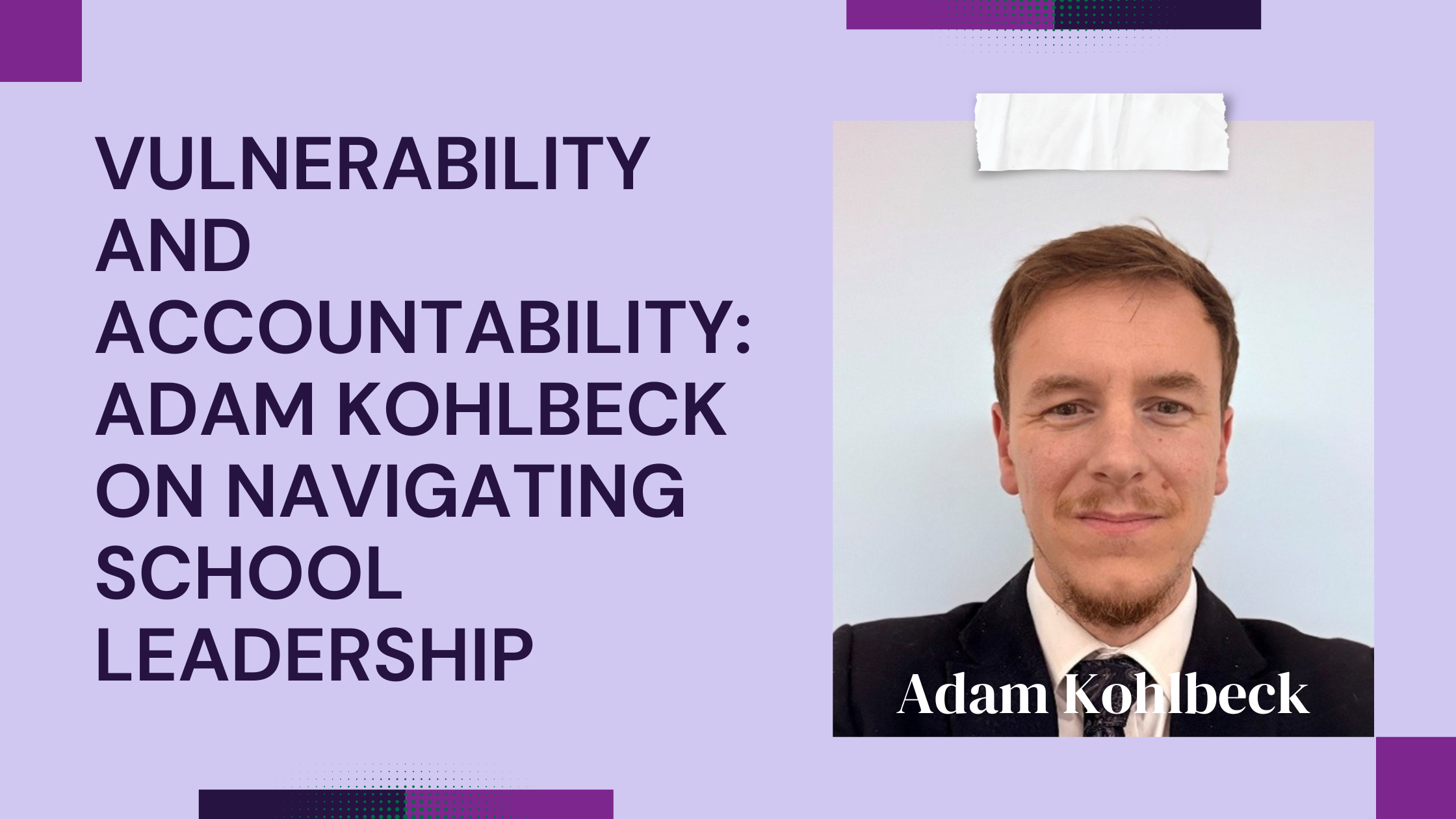
With constant pressure to get the most out of your staff, school leadership can often embody the adage “It’s lonely at the top.” Adam Kohlbeck, one of the speakers at the 2026 International Leaders Conference, believes that the education sector needs to reevaluate how it approaches school leadership and evaluation. In this Q&A, he discusses how accountability culture can be negated from effective leadership, and how the sector can change its leadership approach.
Tell us about your background.
My leadership journey has been quite broad and varied. I’m currently Director of Teacher Quality at Chiltern Learning Trust, which is a large trust serving primary and secondary schools across the East of England. Prior to that, I’ve been a Deputy Headteacher at a primary school and at an all-through school.
I’m particularly interested in vulnerability and accountability, and how we can manage those at scale in leadership roles. I think vulnerability and accountability are something we’ve got wrong as a sector, in that our high-stakes accountability system can make it hard for people to accept vulnerabilities in themselves and others.
We have this idea of accountability as proving to the person one rank above you that you can get the person one rank below you to take action, but that is an unhealthy way of seeing things. I’d like people to see accountability less like a hierarchy and more as a circle, where you have a shared aim in the middle, and everybody is accountable for achieving that objective.
What is the biggest challenge school leaders face right now when trying to implement change?
I think it’s probably the high-stakes accountability system we’re living in. It creates a real temptation to lead with performativity rather than genuinely good teaching. I see and hear from a lot of school leaders who are quite concerned with the idea of consistent practice in the classroom. I understand why the instinct is there, because when you have a system that judges you on one and a half days when a few strangers come into your school, it’s natural to work towards the things they’ll see quickly and can make a judgement from.
But I think it’s a mistake to view consistency in a school as being about what people actually do in classrooms. Really, it is about having a consistent way of thinking and talking about teaching but not a consistent way of doing the teaching, and that’s not necessarily something that would get picked up in a one and a half day inspection.
Why do so many promising initiatives fail in schools?
The first reason is that often they just weren’t that promising to begin with. When adopting a new approach, schools must consider how it will fit with their particular school and culture, not just whether it worked somewhere else. For example, a directive model of instructional coaching may work well with early career teachers who need hands-on support, but it’s unlikely to land in a school where experienced teachers have autonomy. That doesn’t mean the coaching is bad – it just means the culture’s not right for that initiative.
The second reason is implementation. I think a lot of bad implementation in the UK comes down to school improvement plans. School improvement plans often have four or five different targets, each assigned to a senior leader. If you’ve got four or five senior leaders with different targets, what you’re ultimately doing is splitting everybody’s attention. All those senior leaders will be sending out conflicting signals about what’s important.
What does effective leadership look like in practice today, not just in theory?
Leaders need to make sure they have teaching and learning at the forefront of everything they do. As a sector, we’re pushing leaders further away from the core work of teaching and learning all the time. But really, learning is key. So as a leader, you’ve got to be asking yourself all the time if what you’re doing is having a tangible, direct impact on learning.
The other important thing is just to be a good person. Sufian Sadiq, my boss at the trust, talks about being a “good egg”, and I don’t think it needs to be more complicated than that. If everyone trusts that you’re a decent person who wants the best for everybody, that goes a long way towards securing effective leadership.
Why is it important for school leaders to come together at events like our ICA conferences?
It’s about having time to think. Leadership is like a treadmill where you get sucked into the detail day in and day out, but you must have time when you step away from it. If you don’t make that time to think, you’ll get to a point where you plateau or even regress. You need to allow yourself to look at things from a different perspective.
What advice would you give to school leaders who are feeling stretched too thin?
Again – ironically, I think it’s about creating time to think, but its also important to reframe how you’re feeling in terms of good stress and bad stress. Sometimes we’re stressed because things are going wrong, but often it’s because we can achieve something brilliant and are worried about making the most of it. Taking a step back and understanding the source of our stress can help us work out whether it’s bad stress or a motivator we should embrace.
What’s one idea you hope to challenge in leaders’ thinking?
We can fall into the trap of thinking there’s a certain way we have to lead – whether that’s because of pressure from social media or peers, or just because of a lot of regulation that dictates how things should be done. My number one idea I’d like leaders to think about is that we can push back on those things a bit. Leaders need to think about the individuals who are working in their schools, and sometimes that means doing things slightly differently. If you put people at the heart of it all, and you make sure that everybody gets what they need, then you won’t go far wrong.