Español
 Nederlands
 Chinese Mandarin
By Jolinda Groothedde, IEYC and IPC Curriculum Coordinator
At Holland International School (HIS) in Singapore, our approach to professional development has evolved significantly over the past year. Following our International Early Years Curriculum (IEYC) Recognition Report, we spent the first six months focusing on the recommended improvements within our Early Years provision. However, it quickly became clear that traditional all-staff meetings were not enough to create meaningful, lasting change.
Despite shared intentions, there was considerable variation between classrooms. Approaches to play differed, learning environments were inconsistent, and -perhaps most importantly- teachers did not have a clear understanding of each other’s practice. There was also a noticeable gap between Phase A and Phase B, even though learning in the Early Years should follow a continuous developmental journey.
We needed a different approach, one that would make practice visible, strengthen collaboration, and anchor professional development in what matters most: children’s learning.
Creating a shared understanding of quality
Our starting point was to build a shared definition of high-quality Early Years practice. As a team, we developed a “quality map” centred around play, identifying our collective understanding of the why, how, and what of learning in our school.This process was crucial. By making our thinking explicit, we created a common language and a clear reference point for all staff. It allowed us to move beyond abstract ideas and begin aligning our practice. With this foundation in place, we were ready to take the next step: bringing these ideas to life in the classroom.
Making practice visible
Rather than discussing teaching in theory, we invited teachers into each other’s classrooms. During a dedicated session, every teacher presented their learning environment and shared their vision of effective Early Years education.
The impact was immediate. What could have been a routine meeting became an energising and inspiring experience. Teachers spoke with pride about their classrooms, their choices, and their belief in the importance of play. Colleagues asked questions, challenged thinking, and made connections across phases.
Time passed quickly, an indication of genuine engagement. More importantly, it sparked curiosity. Teachers wanted to learn more from each other. We captured these classroom visits on video, allowing staff to revisit them afterwards with a clear focus: which classroom inspires you most? Where would you like to learn more?
Building collaboration across phases
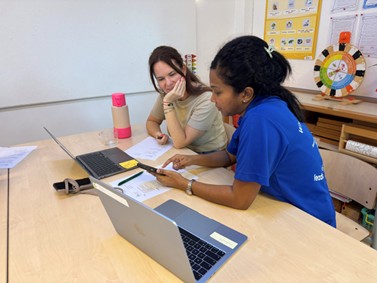
We subsequently formed pairs of teachers across Phase A and Phase B. This was a deliberate decision to address the gap between phases and strengthen continuity in learning. These pairs began observing each other’s play-based learning sessions. Each teacher brought their own inquiry question -something specific they wanted to explore- while also focusing on a shared goal: identifying where and how learning was taking place. This shifted the purpose of observation. It was no longer about evaluating teaching, but about understanding learning.
Follow-up discussions became a key part of the process. Teachers reflected together on what they had seen, shared insights, and discussed how practice could be strengthened. Because these conversations were grounded in real classroom experiences, they were both practical and meaningful.
Deepening professional dialogue
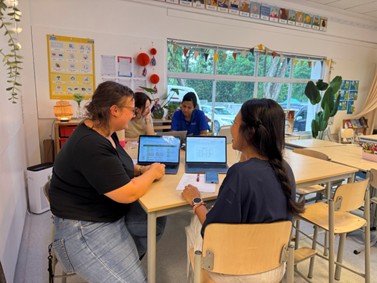
To support this work, we restructured our meetings. Rather than using them for general updates, we focused on key themes, such as planning, observation, and the learning environment. Teachers shared what they had observed in their partner’s classroom, what had inspired them, and what they were beginning to apply in their own practice. These discussions led to deeper professional dialogue across the whole team.
In addition, teachers worked in pairs to review each other’s planning. They explored how play-based learning was designed, how learning intentions were embedded, and how experiences were adapted to meet children’s needs. This introduced a level of constructive challenge that had previously been missing.
Recognising and using strengths
An unexpected but valuable outcome of this approach was the increased awareness of individual strengths within the team. By observing each other in practice, teachers began to recognise the expertise around them.
Some were particularly strong in designing engaging learning environments, while others were strong in facilitating high-quality interactions or observing children’s learning. This created a culture where teachers knew who to approach for specific support, making collaboration more purposeful and effective.
In a context where Early Years teaching requires significant time and preparation, this has been essential. By working more strategically together and drawing on each other’s strengths, we have been able to improve both efficiency and quality.
Strengthening consistency and continuity
Through ongoing observation, reflection, and dialogue, we are developing a clearer picture of how our shared why, how, and what should look like in practice.
This is beginning to strengthen the continuity across the school. Teachers now have a better understanding of what happens before and after their phase, allowing them to build more effectively on children’s prior learning.
Author