Search List show here

Back to news

10 May 2022

Great Learning Nederland

For over 10 years, the International Curriculum has been made available to schools in Dutch. We share the good news that we are successfully continuing the longstanding relationship with Great Learning Nederland.

We have made great efforts to increase the accessibility of our International Curriculum with translations into Chinese and Spanish recently, however, our largest single market is that of the Netherlands.

We have since then evolved to develop our standalone International Curriculum consisting of the International Early Years Curriculum, International Primary Curriculum, and International Middle Years Curriculum. We have been working with Great Learning Nederland to provide our International Curriculum in Dutch, providing over 400 state school’s access.

Robin Belles, Director of Great Learning Netherlands says, ‘Great Learning Nederland is proud to have renewed its licences with Fieldwork Education. The continued collaboration between our two companies, together with the new curriculums that Fieldwork have brought out, provide us with an exciting future to help continue to improve children’s learning.’

Improving learning is what our International Curriculum aims to do. Congratulations to Great Learning Nederland for their successful renewal of the agreement and to us all who are striving to improve learning in schools around the world.

‘The relationship with IPC Nederland is one that Fieldwork Education has enjoyed for several years and is one that benefits hundreds of schools across the Netherlands and their thousands of learners. We are delighted to extend the working relationship between our two organisations for the next 5 years to help improve learning in the Dutch language and across the Netherlands and look forward to seeing the reviewed International Curriculum supporting those in schools from next year and beyond’  – Gregory Biggs – Director of Fieldwork Education

Back to news

24 April 2022

How the International Primary Curriculum has improved every element of Green Dragon life

THURSDAY 28 APRIL 2022

How the International Primary Curriculum has improved every element of Green Dragon life

PrimaryFacebookTwitterLinkedInEmail

Green Dragon Primary have used the International Primary Curriculumto improve our school for well over ten years now. Making the Personal Learning Goals our own over the years, we’ve received countless brilliant training sessions from the IPC staff.

These sessions helped us to embed the IPC Personal Learning Goals, but also to realise (quite quickly) that we needed to personalise them. We involved our whole staff team (SMSAs, office staff, teaching staff) to learn the purpose behind the goals first. After that, we were able to describe how we wanted children to be when they leave Green Dragon at the end of Year 6. With this in mind, we created our own nine Personal Learning Goals. They were based on the IPC’s, but we edited them slightly to fit our community. We wanted aspiration and ambition to be part of our goals, for example, once all staff had helped to make them, we were ready to share them with the children and parents. We had come to realise that we wanted a way to help children know, use and understand the goals more.

We decided upon characterising our personal goals. Within an hour of discussing, we had nine brand new personal goal superheroes ready to help our children prepare for the changing world around them! Children, staff and parents loved them and began to learn more about them. We had days when children came in dressed as a personal goal superhero. We held parent workshops where children trained parents to know more about them and how personal goals are important in all areas of life.

A challenge we face is ensuring children, parents and new staff don’t call our personal goals just ‘superheroes’. Resilience at Green Dragon is represented by a cartoon character called Resilient Robin, but we still must describe this characteristic as ‘resilience’. We still must ensure our staff and community know that resilience is a skill that we practise. The skill of resilience helps us to become better at handwriting or basketball or drawing maps. Resilient Robin helps us to become more resilient by reminding us to keep trying, to ask for help, to never give up BUT Resilient Robin isn’t the personal goal!

Making the IPC Units our own

We are a state primary school in the West London county of Middlesex. As we are a state school, we have to follow the National Curriculum. This means that we have to ensure that, through the IPC units (we call them projects), cover all areas of the National Curriculum. Our staff and community love the IPC and couldn’t imagine Green Dragon without the IPC, but we have had to make some amendments to make sure it works for a school with very high levels of children with SEN and the undeniable pressures of OFSTED.

Over the past few years, we have created curriculum maps that show the IPC units, the National Curriculum learning goals (also taken from the IPC units) and other areas of our curriculum. We begin every autumn and spring terms with Brianwave units. In Autumn, these are heavily based on the IPC Brainwave units for each Milepost. However, the spring unit is more planned to what the needs of the class and year group are. For example, where a class may need more support with resilience or team building, we spend the time focused on personal goals. If a class needs more help identifying, remembering and specifically discussing the subjects then that would be the focus. The IPC Route Planner has helped us, for years now, ensure that our curriculum maps cover all areas of the NC.

To make sure that our curriculum covers all areas of the National Curriculum in the way we want our subject areas to progress, we have sometimes amalgamated two projects together.  In Year 4, we have merged ‘Turn it Up’ and ‘Shake It’ into one science heavy project where children explore Solids, Liquids and Gases before moving to learning about sound. We found that the link between particles helped us to form one project and to create one corresponding knowledge organiser.

As we now have several members of staff who have taught the IPC for many years, and have been on countless training sessions in school and out, we have also felt empowered enough to create some of our own IPC projects. We have made a local history project, a local geography project, and WW1 and WW2 projects. All these projects have the same knowledge organisers as the IPC projects (we make our own knowledge organisers for every project using the IPC Big Picture pages to support with ‘key facts’) and follow the same learning cycle, for example, Entry Point, Knowledge Harvest.

Making the Knowledge Harvests our own

Teachers have regular IPC training sessions built into the year. We always start the academic year with full days of IPC training, and then many many Monday evenings are spent working on areas that have been identified as needing more support.

  • How does a subject progress through an IPC unit?
  • How do we teach for memory?
  • How do we research and record in different ways?

During the days at the start of this academic year, teaching staff were taught areas such as: how to plan a unit; how to plan a lesson; the importance of explicitly teaching personal goals, and some ways to do this; retrieval practice. With these areas in mind, and our worry about gaps due to lockdown, we have slightly edited our knowledge harvests. Over the years, we have tried different ways to find our children’s starting points so we can plan more bespoke lessons and then ways to assess their progress at the end through a learning review.

One knowledge harvest/learning review that we loved a few years ago was taken from other IPC schools- it’s always good to pop around to explore other schools! We used to give children an activity sheet (writing/ labelling/ drawing) to complete with questions based on the IPC unit and suggested Knowledge Harvest. Children would complete this at the start, and again at the end of the unit. We use our Knowledge Organisers and curriculum maps to do ‘backward planning’. We ask questions like:

  • What is the main subject of this unit?
  • What do we want every child to know / be able to do better by the end of the unit?

These help us to create short assessment activities which help pitch planning. As a result of lockdown gaps, we are often having to go back to previous year groups. For example, Year 5 often have to do a Knowledge Harvest based on Year 3 areas of learning to check their memory of these areas first.

As with most in the world of teaching, we are faced challenges to overcome daily, and will continue to do so. For example, with new headteachers came new school visions, and with new visions, the Personal Learning Goals became jeopardised. We’ve been lucky that although the wording or aesthetics of our vision may have slightly changed over the years, our goals stay at the forefront.

Back to news

7 April 2022

Hybrid Learning with Healthy Habits – Apple Green School

Due to the Pandemic, we have been shuttling between online and in person classes. There have been many challenges, however after persevering we are now delighted on the return to the ‘norm’ (however slowly it may be).

At the Apple Green School, we have a growth mindset within the teaching team and despite the switching of in person to online learning we managed to resume the new International Early Years Curriculum (IEYC) Healthy Habits unit. We began with the vision of reinforcing the core lesson of the unit, which is to inculcate healthy habits. The updated IEYC Process to Facilitate Learning is wonderfully designed and through the ‘Ready Steady’ resources we were able to channel children’s curiosity by steering it beautifully towards the learning idea of the unit.

We were conscious that online learning would take longer, and the activities would have to be curated, keeping in mind the limited screen time. So, we incorporated a wide plethora of activities that created excitement amongst our young learners. Here’s a sneak peek into what we did!

Feeding the Brain

As we prepared the unit, one of the main aspects to think in depth about was the ‘learning link’. How could we further the children’s learning experience at home with their parents? How could we create a connection to the local culture of Oman?

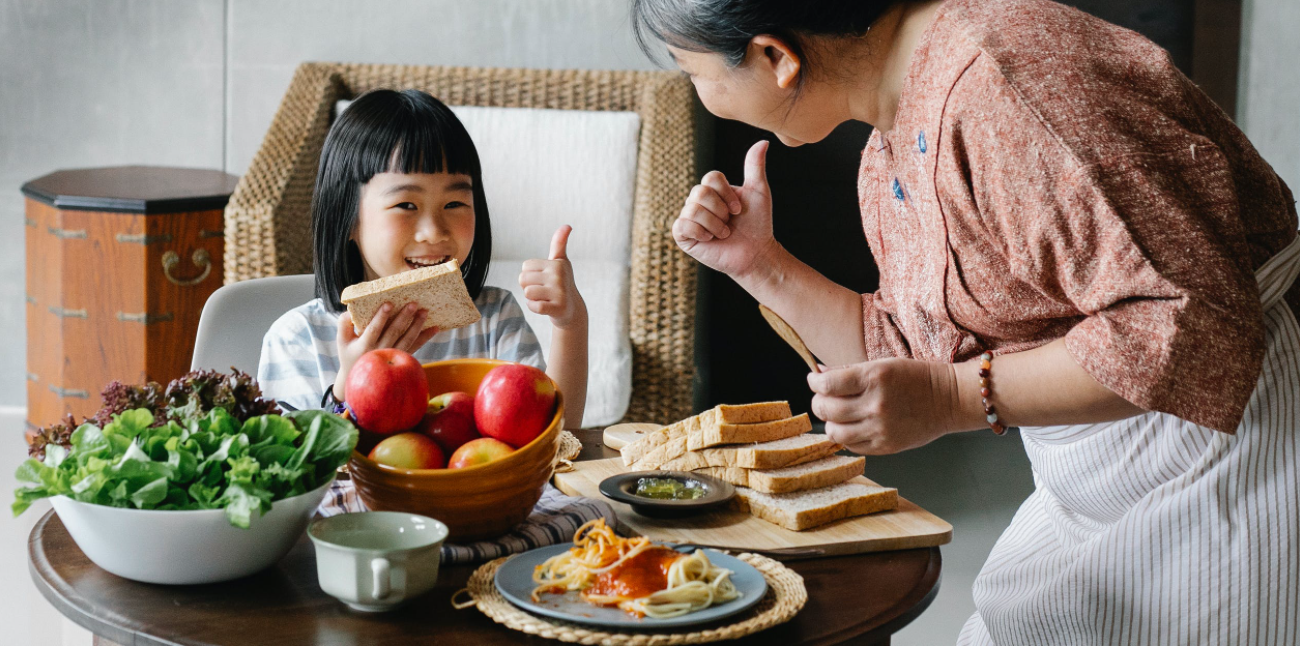
As a team we decided that ‘Waking up to a healthy breakfast’ would be the perfect opportunity to provide children a chance to learn at home. The local breakfast includes khubz (a flat bread), honey, beans, yoghurt, fresh fruits, fruit juice, eggs, and milk. We asked parents to keep each ingredient ready for each day of learning.

To further the learning even more there were virtual tours to farms and bakeries. The children then shared their experiences of visiting these places with each other. The children watched videos of healthy breakfasts across the globe and our classes resonated with other children around the world as they saw mums and dads encourage their little ones to also have milk! This entry point culminated fantastic experiences, and to top it all off we had an online breakfast extravaganza, where the children also learnt the vocabulary of ‘Nutrition for the brain’. The importance of having a healthy breakfast for a healthy start of the day was reiterated, the children had fun and learned important healthy habits.

Fabulous Fruits

We took a virtual trip to Africa as we explored fabulous fruits within the story of Handa’s Surprise by Eileen Brown, some familiar and some strange. We learnt that the fruits found in local supermarket food shelves go through a long journey before reaching the food shelves. We had a fruit hat day to resemble Handa’s basket of fruits. A showcase of creativity and playful learning experiences followed as children constructed fruit faces.

Eat Your Greens

We introduced a relatable story for the children as they learned about a picky eater, in Oliver’s Vegetables by Vivian French. Children explored the different vegetables and luckily, we were able to resume in person learning during this time and we took this opportunity to visit the backyard school farm. Through the week we saw green tomatoes become big and red and green chillies grow longer and red too. Little scientists were in action as they explored and drew in their journal which vegetables will sink and which of the vegetables will float. They were in awe of the butterfly lifecycle also, a delightful bunch.

The food parade

Look! A walking watermelon and a jumping strawberry. For our unit Exit Point each child wore a fruit or a vegetable costume to school and spoke about the relevance of them. We held a fruit parade and pledged that we will eat healthy and respect all fruit and vegetables. We learnt that fruit and vegetables grown locally leaves less of a carbon footprint than the vegetables that travel around the world to get to the supermarket. We talked about being ‘green’ and sustainability with the children. For an activity, classes made leaf prints on recyclable cloth grocery bags. The Exit Point week gave plenty of opportunities for the children to reflect upon the leaning block about feeding the brain. Healthy Habits is very well structured and apt in a time when nurturing ourselves to be healthy and immune is the need of the hour. The unit was much appreciated by parents and children as their food platter looked healthier than ever. We hope to continue to be healthy and include these new habits throughout the children’s time at Apple Green School.


Healthy Habits is very well structured and apt in a time when nurturing ourselves to be healthy and immune is the need of the hour. The unit was much appreciated by parents and children as their food platter looked healthier than ever. We hope to continue to be healthy and include these new habits throughout the children’s time at Apple Green School.

Back to news

24 February 2022

Sustainability and Biodiversity at JFK International School

John F. Kennedy International School is a school community that encourages and supports its students to participate in an outdoor, active and sustainable educational lifestyle. The school advocates real-life learning opportunities regarding local and global sustainability and encourages students to understand the individual role that they can play in improving our ecosystem.

As part of reaching the UN 2030 Sustainable Development Goals within its International Primary Years (IPC) and International Middle Years (IMYC) Programmes, the school made an active choice to support the Votre Cercle de Vie sustainable project in nearby Chateau d’Oex, Vaud.

One of the goals of this collaboration is to bring the children closer to nature and to understand the importance of the different actors for the balance of biodiversity.

Planting fruit trees, discovering permaculture vegetables, learning about bees and rare animals, or making cheese themselves are just some of the experiences JFK students have had at the biodynamic farm.

These various activities are designed to help students discover biodiversity, gain a real understanding of our natural habitat through practical projects, and raise awareness of its preservation.

This year, JFK grade 8 and 9 students have been directly involved in the envisaged eco-hotel. Students Stella and Salma from JFK explain the project on camera here.

JFK students develop creativity, problem solving and develop team building skills. This links back to our IMYC sustainable goals and future unit work. The students are able to reflect on their learning in their learning journals following all workshops, developing deeper thinking skills and reflective learning. 

For both Votre Cercle de Vie and John F Kennedy International School, it is very important to educate students and raise awareness, especially among the younger generation, who will help to “build the world of tomorrow”, a more sustainable world.

Back to news

21 February 2022

Young Entrepreneurs

Year 3 students from the The Grange Institution and International Preschool recently completed a Design Challenge as part of their Young Entrepreneurs International Primary Curriculum Unit of Learning.

Every Exit Point is a great opportunity for students to share their Knowledge, Skills and Understanding with the community. And what an excellent opportunity to witness their Personal Goals in action too.

Creativity is the DNA of The Grange. This project to design The Perfect Wheelchair directly links to many of the schools 8 Key Competencies of their Creators-in-Action philosophy: Teamwork & Partnership, Recognising Issues, Construction and Design, original Ideas, Active Citizenship and Service Leadership.

The Grange also educate their children that entrepreneurs must not always be focused on making a profitable business; they should also be guided by a mission of how to enrich and better others’ lives!

To assess and give feedback on their final presentations, The Grange invited colleagues from the marketing department and a real-life young entrepreneur to judge the winning design.

Due to COVID reasons, the students were unable to present in front of their parents, but a clip of the video, along with feedback and reflection, was sent to their parents. Enjoy the video!

https://youtu.be/G6FuipdQ5AQ

Back to news

15 February 2022

The Knowledge Harvest in Action

For the past two academic years, I have been fortunate enough to be the International Middle Years Curriculum coordinator at Futuraskolan International School of Stockholm (FS-ISS) in Sweden. 2020-21 has unequivocally been one of the most demanding academic years for educators, but it was also productive and rewarding as we succeeded in our joint IPC/IMYC Accreditation process.

The driving question for us was twofold: do our learners know why they are being taught what they are being taught, and how to progress in their learning? 

From the very beginning, we directed our focus on understanding the IMYC2020 updates to the Process to Facilitate Learning, and to expand our practices to better address each of its steps. What I consider a success story is the effort, creativity, and adaptability our enthusiastic team of teachers showed when it came to the Knowledge Harvest.

The Knowledge Harvest 

To fully understand the significance of the Knowledge Harvest in the IMYC, one has to realise that the Learning Process is not a cycle with a beginning and an end, but a series of recurring steps, intricately connected with each other as well as with past and future units.

It is undeniable that students learn when the knowledge and skills taught relate to their interests, and when they understand how the new learning will support their academic and personal growth. This has to be the first step, and it can be attained through a carefully planned, exciting Entry Point activity that explains the Big Idea of the unit and outlines the goals the students will develop in their different subjects.


Common mistakes and how to overcome them:

Generating interest and excitement in the new unit of learning is a start, but it shouldn’t end there. It is here and now that learners can already start reflecting and making connections to previous themes and topics, and think ahead to how their new unit will build on, but also differ from what they already know and are able to do. We as teachers can provide students with the opportunity, the tools, and support to raise appropriate and relevant questions. This is where the Knowledge Harvest starts, but it is also the point where one can make a crucial mistake.

Through trial and error, we came to realise that the Knowledge Harvest cannot merely be a spontaneous, brief discussion in which learners simply generate questions about the new topic and share what they already know. Appropriate time needs to be made in the planning for students to return to those questions and explore them, drawing on the new learning, as well as to reflect on the progress of their knowledge and skills throughout the unit.

Simply completing a Knowledge Harvest task as a disconnected step and moving on will never be adequate. This is when we realised that our unit planners have to be living documents rather than prescriptive ones. In that sense, we as a team of teachers had to model Adaptability, by updating our planning to address our students’ interests and needs, and to recognise our successes and failures. An effective way to maintain the standards and core of a unit while making the necessary changes in the planning was adding a feedback section to our unit planners, noting down what went well and areas for improvement.


The Knowledge Harvest in Practice

What started mainly with learner-generated questions on post-it notes and Know-Want to know-Learned (KWL) charts, developed into a greater variety of practices: 

  • Braindumps – which give students the opportunity to brainstorm their existing knowledge on a topic (you can make this more fun by giving them a sketch of the human brain to write on); 

  • Charts – in which students can record their assumptions and preconceptions, to review them later on in the unit; 

  • Game-based learning platforms –  such as Kahoot, Quizizz, and Quizlet, as well as online pre testing platforms, such as Socrative and Google Forms, which can later also be used for post-testing, thus enabling students and teachers to compare the initial with the final results. 

When it comes to harvesting skills, the IMYC has provided us with an invaluable tool—the Assessment for Learning (AfL) Programme. One of our practices is to provide students with skills-based tasks similar to but shorter than the summative assessment or unit projects. The learners have opportunities to self or peer-assess their work, receive advice from the teacher, read and evaluate sample work, all the while using the Beginning, Developing, and Mastering-level descriptors found in the AfL rubrics. Much like with knowledge, students can keep track of their development and identify connections in the skills required across units and, often, across subjects.


You reap the harvest you have sown

Once reinforcing links established in the Knowledge Harvest became a standard and consistent practice, learners were able to independently make connections between previous and current learning, express how subjects are interlinked through the Big Idea, as well as talk about their progress throughout units and academic years. To further support our students this academic year and in the future, we will continue having discussions on our best practices and our less successful moments. 

We recognise that more progress can be made if you share and exchange ideas on implementing the IMYC.

Find out more about Knowledge Harvests and the role they play in the Process to Facilitate Learning with Maria Koutsoupaki in the fourth episode of our International Curriculum Specialist Series.

Back to news

27 January 2022

Planning, Monitoring and Reflecting

Long-term planning helps you see the breadth and sequence of expected learning within a Milepost, Key Stage, or grade level. If changes are made to long-term plans, (for example, the selection or ordering of units) the consequences may not be initially obvious.

Changes to plans need monitoring and attending to, consider the following:

  • Is the breadth of learning still varied, relevant, and engaging?

  • Does the sequence of learning still make sense? Does any particular unit need to come before another one?

  • Are there repetitions causing redundancy in learning, as opposed to revisiting and extending which learners will benefit from?

At this planning stage, thought can be given to field trips and visitors. While more details of these will be included in both medium and short-term planning, if there is a key local resource make arrangements now so you don’t miss out on using it to improve learning. Fingers crossed field trips can be included in plans for learning in the coming year.

Medium-term planning for the International Primary Curriculum (IPC) is a thematic unit, in other curricula it could be a topic or period such as a 1/2 term. Gaining an overview of anticipated learning is a good opportunity to make links between different subjects. As the brain learns associatively, looking for patterns and connections, and identifying these connections to explicitly draw learners’ attention to, will improve learning. 

But the sequence also matters, if the children will be creating an advertising campaign for a product, there are benefits to learning about advertising features and techniques before and not at the same time as creating. Firstly, it avoids cognitive overload which suggests acquiring domain-specific knowledge before using it in novel ways will not demand the brain does two things at once and should result in more effective learning. Secondly, applying knowledge of advertising techniques after learning demands knowledge recall, which supports retention, and connecting it to a context will strengthen neuronal connections, essential for acquiring knowledge, developing skills, and deepening understanding.

Short-term planning for learning is not a paper exercise that fits into neat little boxes, like a learning journey it is messy and will need adapting as learning progresses. If you try and plan a whole unit before the first step on the journey, your learners are less likely to reach the desired destination. 

The IPC thematic units begin with an Entry Point followed by a Knowledge Harvest, these provide the information a teacher needs to begin detailed planning. Providing a ‘hook’ primes children for learning by promoting curiosity, attention, and engagement. (Read more on this from Judy Wills here).

Previous learning and memories will be activated, which means if you follow the ‘hook’ with an initial assessment, rather than the other way round, you will get better data to plan from. Planning can now be thoughtful and learning-focused, you also have the initial data to help you identify the anticipated needs of learners and can plan for how you can support these through differentiation.

Many things impact on learning and therefore many elements to consider when planning:

  • The organisation of children: individual, pairs, groups, whole class. Will there be choice, or will it be directed?

  • Resources for research: Will these be the same for everyone? How will they be made accessible to each learner? Will they be levelled, presented in different formats or will assistive technology be provided? Will there be a choice?

  • Method or process: Will everyone do the same activity? Can choice, which motivates learning through increasing relevance be offered? How will all learners be appropriately challenged?

Planning where the learning is headed (Learning Goals or outcomes), indicates who has reached the goal, what the evidence looks like, and what happens in between (the path the learning will take). While the destination is largely the same for all learners, the journey can be quite different as can the assessment, children can show their learning in a variety of ways.  

Planning for monitoring is also needed as monitoring learning through formative assessment will have the biggest impact on subsequent planning. At the most basic level, the data you collect may indicate whether you can move on or if you need to plan for other ways to help make learning happen. Questions or strategies need to be included in it, without this teachers might not ask the most effective questions that provide feedback on the learning taking place. Taking part in monitoring cannot rely on just a few learner responses. Technology (e.g. Plickers), whiteboards or letter cards can all facilitate whole class participation. (Read what Dylan William has to say on this here).

Planning at all levels is ‘an essential contributor to effective teaching and learning’ (NASUWT) and how this is approached can vary vastly. Does your current approach enable teachers to improve learning? Is the new school year a good time to reflect on planning in your school?

Back to news

18 January 2022

How we can help children learn in a pandemic

We have all read and digested more information on COVID in the last two years than we could ever have imagined. Two years ago, we didn’t know that by 2022 we would all be experts in epidemiology, mental health, online pedagogy, and government pandemic policy design. Yet here we are.

I viewed the pandemic through different lenses: as a parent of two teenagers, as an educational consultant with a business that thrived on in-person activity and finally, as a Head of School. My educational consultancy business thrived at first with online professional development and consultancy, but it left me feeling bereft of human contact and work just wasn’t enjoyable. 

Hence, finding schoolwork and experiencing the last six months in India as a Head of School. Funnily enough, the lens that gives me the greatest insight is that of a parent. As a home-based consultant I saw, heard, and felt what they were going through. One child loved being able to work quietly without classroom distraction and without being dressed. The other hated it, was totally lacking in motivation and his mental health was hard hit and his self-confidence evaporated.

Schools have reacted and adapted with astonishing pace, but it has taken a toll on school leaders, teachers, students, and parents. I know that many papers say that ‘learning loss’ is a myth and that students learned other things and there was no loss as such. Many students thrived, enjoying independence, studying at their own pace, and having no travel pressures.  

However, the majority I would contend suffered. They learned less, they missed the social experience of learning and they missed out on the wonderful relationships in schools that support learning. I see primary children that have missed two years of writing practice as parents have hovered over their shoulders ensuring all work is completed, we see students struggling to negotiate over space and resources and students who simply missed fundamental concepts whilst being distracted by ‘other devices’.

As the world responds to changing variants and differing rates of vaccinations, we are looking at a future of in/out decisions and online/offline learning that will be the norm rather than the online or offline version. I spoke to members of the student council at Sreenidhi International School in Hyderabad, India, which is where I now enjoy daily human interactions! Having seen my own children in the UK battling with the online learning component of COVID I wondered what the Sreenidhi students thought of it, and what we should take with us in the future, because it wasn’t all bad was it? I asked the students a range of questions thinking about experience and future potential.

If you could give advice to a teacher regarding online teaching, what would that be?

  • Present something visual on the screen as they teach

  • Include more activities in each class that is separate from the normal teaching

  • Teach using resources that can be accessed online

  • Always record the lessons

Do you think learning online should follow the same schedule as when you’re in school?

I believe that modifying the schedule to have fewer lessons would be the better option when thinking about screen time. It is not good for students to be spending long hours on their electronics.

On returning from online learning to the school environment, what is important? More focus on socializing? Cramming missed content?

I think there should be a balance. Giving students this time to socialize will give them more energy to pay attention in class because they know they have time to talk to their friends. 

What elements of online learning worked well?

I think that online classes should continue to remain an option even though students are coming back to campus. If a student is sick and cannot attend school, but does not want to miss the content, being able to join online would be so convenient. This would push for less absences and more learning.

What can the school do to better support your learning in the aftermath of a long time away from physical school?

Coming back to school after a long time of being online is exciting for some, but stressful for others. I think the best way to support students is to provide a variety of hands-on activities. Another suggestion would be to have small slots where students can meet with teachers one-on-one after school. The biggest loss for me with online school is not being able to go to teachers and talk to them, whether it is about my grades or a doubt I have about the topics.

Enquire now

Find out more about ICA products and services!