Español
 Nederlands
 Chinese Mandarin


As an educator, I used to enter classrooms equipped with lesson plans, Learning Goals, and activities. I prepared myself to deliver and teach content and lead students towards the desired outcomes. One important lesson I learned through implementing the IPC is that before we prepare to teach, we should listen and understand all the previous knowledge that children walk in with.
The Knowledge Harvest helps teachers find out what children already know and what they want to know.
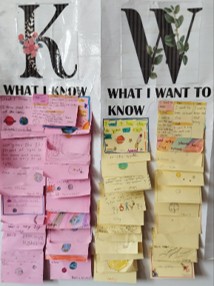
Children may not arrive at our doors eager to be taught. They arrive with questions and stories from home. They arrive with beliefs of their own that have been influenced by the community. Paulo Freire argues that treating learners as empty vessels, what he termed the ‘banking concept of education,’ fails to see the humanity of the child and to release their curiosity (Freire, 1970). Some of the ideas children may bring with them may be correct. Some of them may be incorrect. The teacher must use what they learn about the students to drive their planning.
The Knowledge Harvest taught me something that I had not learned in my teaching practice: learners do not start learning when a teacher begins to instruct. Learning first occurs when a teacher begins to listen. This coincides with what the constructivist, Lev Vygotsky, thought. Children gain knowledge when they build upon what is already known to them, and learning is social and interactive (Vygotsky, 1978).
Two questions posed by learners during the SDG unit, That’s Not Fair!
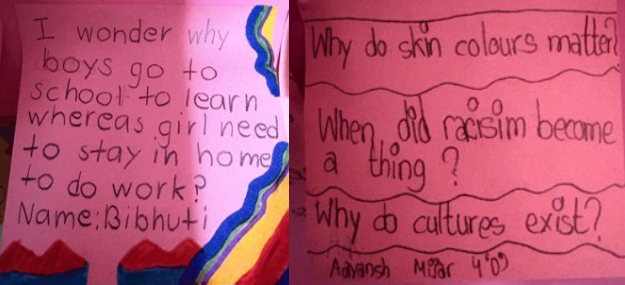
When Children Show What We Did Not Anticipate
As a curriculum leader, I enjoy watching Knowledge Harvest moments that change units of learning. I have spent time at the back of classrooms where teachers have stepped out expecting one answer, only to be met with a multitude of alternatives, each one more interesting than the last.
David Ausubel, with respect to the theory of meaningful learning, has simplified it.
“The most important single factor influencing learning is what the learner already knows.”
(Ausubel, 1968, p. vi).
Children engaging with the Knowledge Harvest for the How Humans Work unit of Learning:
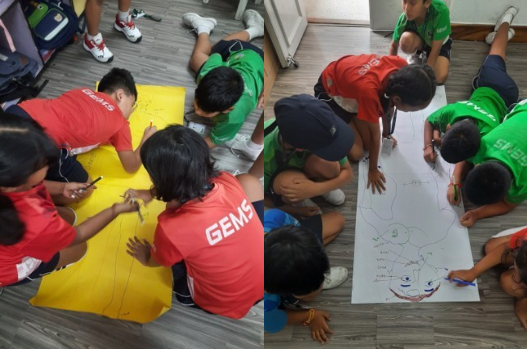
In the classroom, what used to be tentative hands now rise with confidence. I am sitting with the learner who used to remain at the edge of discussions. Now conversations are multi-dimensional and complex, as students connect each other’s thinking rather than waiting or even wanting the teacher to confirm what the “right” answer is.
Moving Away From Assumptions
Knowledge Harvest drives deeper teaching that is more relevant to learners. Without the Knowledge Harvest, this is something that could be easily overlooked. It disrupts our assumptions. As a teaching profession, we can find ourselves unwittingly settling, at the outset of a unit or new learning, on what we assume children already know and what needs to be taught. We plan accordingly, and sometimes we are right.
Knowledge Harvests can be added to or edited during the unit.
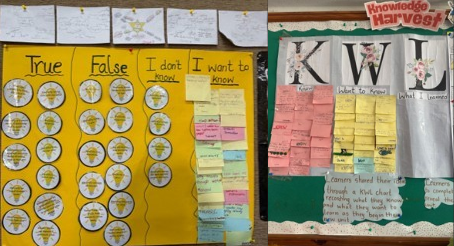
Yet sometimes, we are not, and this is where Knowledge Harvest truly begins to work its transformational magic. Close listening can uncover misconceptions we never knew existed, strengths we had not seen yet, and perspectives that change the whole learning conversation. Grant Wiggins and Jay McTighe argue in their seminal Understanding by Design framework that we must start with a sense of where the students are now, not as dictated by what the curriculum says they should be. Too often, what we teach begins from our assumptions about where people should be by an arbitrary point in time (Wiggins & McTighe, 2005); teaching thus fails to be responsive, is less meaningful, and, to be honest, just more dull.
“What do you think?”
Maybe the biggest lesson, however, that Knowledge Harvest has given me is a reminder of humility in education. Equally often, however, the most empowering thing I could do as a teacher is not to say anything first but instead look around the room and ask a question.
When children actually understand that their ideas really count, they not only learn better. They start to identify as thinkers. As contributors. They interact with learning as their own, not as passengers.
And maybe that is where real learning actually starts.
References
Ausubel, D. P. (1968). Educational psychology: A cognitive view. Holt, Rinehart and Winston.
Freire, P. (1970). Pedagogy of the oppressed (M. B. Ramos, Trans.). Herder and Herder.
Vygotsky, L. S. (1978). Mind in society: The development of higher psychological processes (M. Cole, V. John-Steiner, S. Scribner, & E. Souberman, Eds.). Harvard University Press.
Wiggins, G., & McTighe, J. (2005). Understanding by design (2nd ed.). ASCD.
Author