
 Español
 Nederlands
 Chinese Mandarin


The International Curriculum defines learning as an ongoing process that is “an achievement of the time as well as laying the foundation for new learning”. The early years, a significant contributor to future success, act as a stimulus underpinning personal, social, and academic development.
Coherence and connections between IEYC and IPC are deliberate, supporting schools with curriculum decisions so “children’s learning builds on their experiences in a constructive and informed way”, laying the foundations for learning experiences that are “designed to activate memories of previous learning which then build associations with new learning which is another way to strengthen connections in the brain.”
ICA Working Definition of Learning
The ICA definition of Curriculum
Curriculum in the ICA is defined as the content and lived process of learning. It unifies ‘what is learnt, why it is learnt, the way it is learnt, and the impact on the learner’. The ICA identify 4 distinct facets of curriculum:
- The written curriculum
- The planned curriculum
- The experienced curriculum
- The evaluated curriculum
The International Curriculum is designed to best improve learning in in age and developmentally appropriate ways. Each of the three curricula, the IEYC, IPC and IMYC, can be both a stand-alone and connected phase of learning.
In this article, the Head of Curriculum explores how the four facets of curriculum support connected and coherent learning across the early years and primary phases.
Written Curriculum Connections IEYC – IPC
The seven foundations provide a framework for improving learning across all phases of the International Curriculum. Recognising the distinct nature of learning within the early years, Foundation 1 and Foundation 7 have been tailored specifically for IEYC.
| IEYC Foundation 1 | IPC Foundation 1 |
| Child-focused Personal, International and Academic Dimensions of Learning and Development | Learner-focused Personal, International and Subject Learning Goals |
| IEYC Foundation 7 | IPC Foundation 7 |
| Reflective Practices for Improving Learning | Assessment for Improving Learning |
Learning across the IEYC is holistic and interconnected in nature, and therefore learning across the academic dimension underpins various IPC subjects, contributing to the thematic nature of learning in the ICA and Foundation 6 (Connected Learning).
The focus on Personal and International Learning in both curricula provides further coherence for early and primary learners, with shared language, aspirations and approaches. This coherence has been intentionally designed to support conversations between teachers from different phases.
Planned Curriculum Connections IEYC – IPC
Beyond the shared curriculum structures and systems, the thematic approach of both the IEYC and IPC provides the framework for consistent classroom processes and practices, and rigorous planning of progression in learning.
The breadth of focus within IEYC thematic units means that each Learning Block provides opportunities for learning experiences that introduce foundational knowledge that can be recalled in multiple IPC units. Young children will acquire vocabulary through hearing, seeing and using disciplinary terminology through engagement with IEYC units of learning. This vocabulary facilitates access to primary curriculum engagement.
Experienced Curriculum Connections IEYC – IPC
Central to the Experienced Curriculum is the International Curriculum’s focus on connected learning.
Within IEYC and IPC units, there are activities that can provide opportunities to encourage collaboration between IEYC and IPC learners. For example, in the IPC unit ‘Mission to Mars’ the Design, Technology and Innovation Task 3 has learners designing and building a model of a shelter for use on Mars. This learning and the final creations can be shared with IEYC learners who are engaged with the thematic unit, Blast Off! Learning Block 3 and 4 have particularly strong connections with Mission to Mars as they focus on building a home on another planet.
Look at these two examples from IEYC and IPC Milepost 3 of space buildings. What opportunities might there be for these learners to make connections?
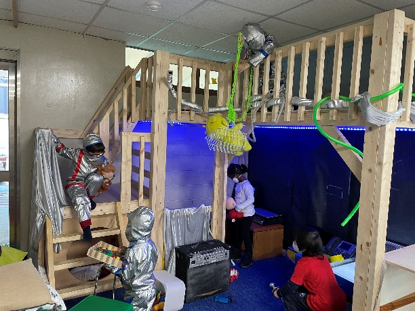
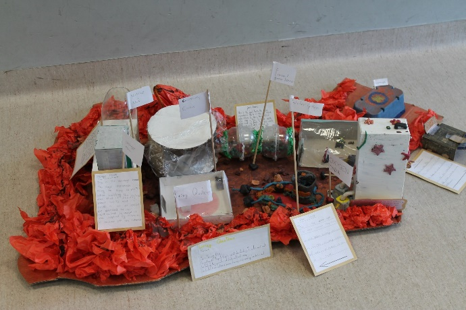
The Milepost 3 unit, Full Power, has a specific Design Technology and Innovation task that encourages collaboration with early years learners who can test and give feedback on the products of learning. Schools can identify further/other opportunities where the early years can be the audience for products, performances and presentations.
Schools are encouraged to look for opportunities to make connections between units and classrooms. For example, inviting peer audiences to Exit Points. An IPC class that is learning with the unit, From A to B, may invite an IEYC class that is currently, or about to learn through the unit Going Places to their Exit Point (or vice versa). The co-constructed nature of the IEYC units increases the potential for schools to identify and capitalise on planned and unplanned links with primary learning and learners.
Evaluated Curriculum Connections IEYC and IPC
The evaluated aspect/facet of the International Curriculum promotes opportunities for schools to evaluate and build on the decisions taken within both the IEYC and IPC with regard to the written, planned and experienced curriculum. Seeking engagement from all stakeholders can inform the process of evaluation from multiple perspectives. Feedback within evaluation can result in creative suggestions for future connections across the phases.
Connected Learning within and across phases of the ICA
The adaptable nature of the IEYC and IPC thematic units and the customised route plans in the IPC make it impossible to provide a definitive cross-reference of the learning connections. However, the ICA is confident that through collaboration early years and primary colleagues can build on the coherence provided by the ICA’s seven foundations and thematic learning to capitalise on curriculum connections that improve learning for all.
The framework and adaptability of the International Curricula enable multiple opportunities for connected learning, creating a coherent learning pathway from early years through primary
To find out more about the International Curriculum available, contact the team today