Search List show here

Fostering Growth: Harnessing Social Emotional Learning for Student Success

In this round-table discussion, the crucial role of social-emotional learning in schools is explored. International classrooms are where many students are first exposed to people who hail from a range of different backgrounds, belief systems and abilities.

Listen as the panel discusses:
  • Defining Social Emotional Learning: Why it’s important for schools to establish clear SEL in their curriculum offering.

  • Effective strategies for integrating social-emotional learning (SEL) into various subject areas within the curriculum.

  • Assessing and monitoring students’ social-emotional development effectively.

  • Ways in which educators can foster a supportive and inclusive classroom environment that promotes students’ social-emotional growth.

  • The role parents and caregivers play in supporting SEL initiatives, and how can educators collaborate with them to reinforce SEL skills outside of the classroom.

Guests
  • Landon Seigler, M.Ed – Middle School Principal | Designated Safeguarding Lead at East-West International School, Cambodia. Representative for the International Curriculum Association
  • Donovan Robus,  Head of SEL & Student Support Service at Hsinchu International School
  • Jonno Melia – Deputy Principal Pastoral & Wellbeing and Designated Safeguarding Lead at Brighton College
  • Corneila Weiner, School Principal at Dubai Arabian American Private School
  • Martin Boother, Senior Leader at GEMS Metropole School

Author

Picture of International Curriculum Association

International Curriculum Association

The International Curriculum Association (ICA) brings together the three age ranges of the International Curriculum: the International Early Years Curriculum (IEYC) for learners aged 2-5+ years old; the International Primary Curriculum (IPC) for learners aged 5-11 years old; and the International Middle Years Curriculum (IMYC) for learners aged 11-14 years old, with Professional Development for teachers and leaders and a two-stage Recognition and Accreditation process for schools, to ensure that with teachers, leaders and schools, we are improving learning, together.

Back to news

17 June 2024

The International Curriculum Association partners with 8billionideas to launch ‘The Critical Curriculum’

The International Curriculum Association (ICA) has partnered with ed-tech and services company, 8billionideas, to further enhance its International Curriculum and launch ‘The Critical Curriculum.’ The partnership will bring together the ICA’s rich educational resources and expertise with 8billionideas’ cutting-edge approach to prepare students for the challenges and opportunities of the future.

The ICA and 8billionideas are collaborating to work with schools in reshaping their curriculum landscapes with curriculum enhancements aimed at equipping students with essential future skills. The ‘Critical Curriculum’ will be structured around a suite of learning pillars.

The first learning pillar to be introduced will be focussed on Entrepreneurship and it will help learners to build a solid, holistic foundation of entrepreneurial skills. It will build an initial understanding of value and worth in the early years through introducing learners to the ideas of commerce in their communities through play-based learning. This will then be developed further in the primary years through idea-to-execution-based challenges. Learning will continue to be refined in the middle years via the means of interactive problem-solving challenges exploring crisis’ on a macro and micro level.

Sarah Blackmore, Director of the ICA, said: “We recognise the need for a comprehensive and innovative approach to teaching that stretches far beyond traditional academic learning. In a fast-changing world, skills such as critical thinking, creativity, collaboration and adaptability have an increasing significance. We are excited to be working together with 8billionideas to provide young learners with the opportunity to develop the skills they require for future success.”

David Harkin, CEO and Founder of 8billionideas, said: “At 8billionideas, we believe in empowering students to think creatively, act entrepreneurially, and prioritise their wellbeing. This collaboration with ICA enables us to amplify our impact, reaching a wider audience with our mission to revolutionise education for the betterment of individuals and society as a whole. We’ve worked closely with the ICA for 12 months to understand deeply its vision for education. In 2024, we will begin by offering all ICA schools a developed and bespoke learning pathway around our entrepreneurship pillar and expand in the years ahead.”

To find out more about how you can integrate entrepreneurship into your curriculum, visit: https://page.8billionideas.com/8billionideas-ica-partnership

Back to news

22 April 2024

Equipping Learners to be Future-Ready: How Cultivating EQ in Middle School Leads to Success

Do you ever wish your middle school learners could navigate the emotional rollercoaster of adolescence with greater equanimity? The key to managing emotions is being very deliberate with Emotional Intelligence (EQ) and how it is woven into classroom practices. While it might not be as flashy as mastering long division, developing strong EQ skills is crucial for your learners’ academic success and future well-being. Let’s explore why EQ is the hidden curriculum that deserves a starring role in your classroom, and how schools like East-West International (EWIS) in Phnom Penh, Cambodia, are using this knowledge to cultivate strong emotional intelligence in their middle school students.

The world our learners are stepping into is rapidly changing. Automation and Artificial Intelligence (AI) are transforming the job market, with machines handling tasks previously thought to be the exclusive domain of humans. This rapid change raises a crucial question for educators: are the skills we currently teach preparing learners for an uncertain future? While the technical skills they learn today might become obsolete, the ability to manage emotions, collaborate effectively, and adapt to change will always be in demand.

EQ is the ability to understand and manage one’s own emotions, while also recognizing and responding to the emotions of others. It encompasses self-awareness, self-regulation, empathy, motivation, and social skills – all qualities that will remain highly sought-after in the future workforce.

At EWIS, emotional intelligence is a key ingredient to student success. Strong communication, teamwork, and conflict resolution – all key components of high EQ – are woven into the learning experiences, creating an environment that promotes prosocial behavior and builds empathy. By fostering EQ in the classroom, learners are better equipped with the tools they need to become future-ready lifelong learners.

How Does EWIS Cultivate Strong Emotional Intelligence in its Teaching Practices?

Here are a few EWIS-specific strategies you can consider:

Emotionally Intelligent Activities: EWIS uses reflection on both academic and social emotional areas to help learners come to terms with their feelings. In writing, they reflect on their progress before and after assessments and offer a personalized opinion on the Big Ideas.

Journaling for Growth: EWIS encourages journaling as a tool for self-reflection. Learners can explore their feelings in a safe space, identify triggers that lead to strong emotions, and develop healthy coping mechanisms. It is also a great way to build metacognition

Cooperative Learning: All educators at EWIS are trained in Kagan Cooperative Learning Structures, which are critical in promoting an environment that builds and maintains relationships. By having these consistent structures in each class, the school is able to frame their learning around the emotional needs of the students as they develop together.

Peer-to-Peer Feedback: EWIS uses a feedback structure called T.A.G. that gives learners the tools they need to feedback to one another effectively. This creates a culture of feedback where learners build positive interdependence in a controlled space. Learners experiment with empathy and effective communication by experiencing it first-hand on a daily basis. 

By prioritizing EQ development, EWIS has created a calmer classroom environment. This fosters a space where educators can effectively lay the foundation for learners to better cope with stress, explore their feelings and learn the impact they have on others. Ultimately, this helps them build longer-lasting relationships, navigate challenges more productively, and become well-rounded individuals with the emotional intelligence to not only participate in the future, but to thrive in it.

The Takeaway

The educational landscape is changing, and students need to be prepared for an uncertain future. While the technical skills they learn today might become obsolete, harnessing the power of emotional intelligence equips students with the ability to manage emotions, collaborate effectively, and adapt to change – skills that will put them at an advantage later in life. By fostering EQ development alongside academics, educators can empower students to become future-proof learners who can thrive in the face of any disruption.

Back to news

22 April 2024

Get to know Chris Barnes from Hillel Academy

1.  Let’s start with a glimpse into your professional journey. Can you share a bit about your background?

My journey commenced at The University of the West Indies, Jamaica, where I pursued both my Bachelor’s degree in Biology with a focus on Education and my Master’s degree in Educational Leadership and Management. These formative years laid a robust foundation for my career in teaching and educational leadership. With a relatively young tenure in academia spanning four years, I’ve been fortunate to embrace leadership roles, including that of a Curriculum Coordinator. Throughout this journey, I’ve remained driven by a profound passion for both the subject matter and the pedagogical process, propelling me to consistently innovate and enhance my teaching practice.

2.   What’s one piece of advice you would give to someone starting out their teaching career and one piece of advice to someone who has been teaching a while but wants to incite change in their school?

One piece of advice for someone embarking on a teaching career is to ensure that their motivation stems from a genuine passion for the field. Teaching demands not only knowledge and skills but also emotional investment. It can be emotionally draining at times, and having a deep-seated love for education is vital for sustained growth and fulfillment in the profession.

For experienced teachers seeking to incite change in their school, it’s crucial to revisit their initial motivations and remember “why” they chose to enter the teaching profession. Reconnecting with this sense of purpose can reignite their passion and provide clarity in driving forward initiatives for change. Moreover, it’s essential for seasoned educators to adopt a growth mindset, viewing challenges not as indicators of inadequacy but as opportunities for personal and professional development. Embracing this mindset enables them to approach obstacles with resilience and a willingness to learn, ultimately fostering an environment of continuous improvement.

3.  When did you/your school begin the journey with IMYC, and how long have you been implementing it?

Our school began its journey with the IMYC six years ago. Since then, we have been dedicated to implementing this innovative curriculum framework, which has greatly enriched our students’ learning experiences.

4.  What are the biggest challenges on the horizon for your context/school?

Our primary challenge revolves around striking the delicate balance between academic rigor and holistic learning while preventing staff and student burnout. While we aim to uphold high academic standards, we recognize the importance of providing a learning environment that nurtures students’ overall well-being and fosters meaningful connections between curriculum content and their lived experiences.

5.  How has implementing the IMYC helped with improving learning in your context/school?

One of the key benefits is the framework’s emphasis on inquiry-based learning, which fosters critical thinking, creativity, and problem-solving skills among our students. The curriculum allows our students to extend their knowledge beyond their context and make international connections, enriching their understanding of global issues and perspectives.

Furthermore, the IMYC’s flexibility enables teachers to personalize learning experiences and cater to the diverse needs and interests of students. This flexibility not only empowers teachers to innovate and adapt instructional strategies but also fosters their professional growth and development. By continually refining their practice and exploring new pedagogical approaches, teachers are better equipped to meet the evolving needs of their students and create engaging learning experiences.

6.  If you could have any superpower related to your work, what would it be and why?

If I could have a superpower related to my work, I’d be thrilled to have the ability to predict the future! Just imagine the excitement of being able to anticipate upcoming challenges and opportunities in education before they even arise. With this superpower, I’d be able to stay one step ahead, dynamically adapting curriculum, teaching methods, and school policies to ensure our students receive the best possible education.

7.  We’d love to know a bit more about you beyond your professional persona. What do you like to do when you’re not working?

Outside of work, I’m all about the thrill of Broadway musicals, the excitement of anime adventures, and the mind-blowing wonders of space exploration! Whether I’m belting out show tunes, binge-watching the latest anime series, or geeking out over space videos, I’m always up for an exhilarating adventure that sparks joy and ignites my imagination! From musicals such as Hamilton to the epic battles of Naruto, I love diving into worlds filled with creativity, imagination, and endless possibilities.

8.  What’s the most interesting thing you’ve learned recently, inside or outside of work?

One of the most fascinating things I’ve recently learned is about the phenomenon of aphantasia, where some individuals lack an internal narrator or mental imagery. This revelation has reshaped my understanding of human cognition and perception, highlighting the diversity of experiences within our own minds. Simply shows how unique we all are.

9.  What’s your favourite way to unwind and de-stress after a busy day?

My favorite way to unwind and de-stress after a busy day is by calling my parents. Every day at 6:30pm, I make it a point to call my mom and dad. This daily ritual not only helps me decompress, but it also strengthens my bond with my family, providing a sense of comfort and support that rejuvenates me for the days ahead.

10. One thing on your bucket list?

To travel the world and connect with different people and cultures.

Back to news

22 April 2024

Spotlight: Being an education mentor

The transition from education to employment can be a daunting one.  A lot of young people face challenges like unemployment, lack of experience, or are simply not sure what direction to take. The Prince’s Trust, a youth charity founded by His Majesty King Charles III, is here to help bridge that gap and empower young people.

For over 40 years, The Prince’s Trust has been offering young people the support, guidance, and resources they need to thrive. They recognise the unique obstacles young people face in today’s world, and through a variety of programs, they equip them with the confidence, skills, and experience to build successful futures.

Lucy Gray who is a valued part of the International Curriculum Association team, took part in The Prince’s Trust’s Mosaic Mentoring Programme, an initiative designed to connect young people with experienced professionals who can offer invaluable guidance and support. We hear from Lucy about her experience!

1. What initially motivated you to volunteer as a mentor with the Prince’s Trust Programme?

I have always held a strong belief in the possibility and importance of social mobility- knowing that if I had met someone I could look up to at a young age, my journey of upward mobility would have been less scary and more efficient/ effective. My primary motivations were to give back, to do something different/ learn something new, and to utilise my unique skills to help others.

2. What did you do to prepare for your first mentoring session?

Preparing for my mentoring session was enjoyable (22  students – 12ish years old)! As an ESOL teacher (in a past life) I was used to creating lesson plans that were high energy and held attention, this helped me to have a clear plan that was easily followed and impactful. It also meant I was comfortable managing a large class and could monitor/ provide feedback effectively. For the content itself, I utilised the Prince’s Trust recommended materials and adjusted these to fit the classroom dynamics and my style. The session itself focused on personal strengths and why these are important – activities included: definition matching, self-assessment, mentor presentations, and more! Key skills focused on: being sensitive, enthusiastic, brave, creative, adaptable, expressive, curious, gentle, generous, adventurous, spontaneous, and kind.

2.  What are some of the biggest challenges you’ve faced as a mentor, and how did you overcome them?

When you’re a new teenager and go to a large co-ed school, there are many social barriers to being true to yourself, courageous about yourself and making the most of a new and unfamiliar programme. The biggest challenge I found was the social unfamiliarity and inability to find group consensus among the students. As the students were chosen across the year by multiple different teachers based on their untapped potential – this meant that many of the students didn’t have a relationship with one another and were very socially withdrawn especially in the first half of the programme – all figuring out their place and what they needed to embody in this new situation. Thankfully time improved this, as trust was built with the mentors and other students week-by-week. We were also able to better personalize our lessons to the needs and temperaments of the students, focusing on more individual tasks, and building up to the group activities instead of jumping right in.

4. What would you say to someone who was thinking about volunteering to mentor?

Making someone feel of value is the name of the game. From this experience, I have realised that the students who get the most out of mentoring are the students who feel seen and know you are interested in them (especially if they haven’t felt like this before). I would recommend having 10+ open questions up your sleeve to facilitate conversation, 100% engagement and a genuine smile.

5.  What do you enjoy the most about mentoring with this program?

It has been a unique opportunity to meet young people and hear about how they interpret and interact with the world. I have enjoyed getting to know the mentees, teachers, and fellow mentors who all come from different backgrounds – policewoman, investment banker, software engineer, and psychology student to name a few. It has been great to expand my knowledge of the world and the others who are sharing it with me, especially knowing that the Prince’s Trust Mosaic Programme is shining a light on the possibility and positivity of tomorrow to the young people who need it.

About: The Prince’s Trust, Mosaic Mentoring Programme:

The Prince’s Trust is a leading UK charity founded in 1976 by King Charles III (the then Prince of Wales) and offers vital support for young people aged 11-30 years through multiple initiatives such as the Mosaic Mentoring Programme. The programme itself pairs disadvantaged youth with inspiring mentors, providing guidance and real-world insights together with a focus on employability skills and confidence building. The programme aims to empower students to overcome obstacles, pursue their dreams and reach their potential.

You can find out more about the Prince’s Trust here: https://www.princes-trust.org.uk/.

Back to news

26 March 2024

World Languages and the Middle Years

When we first introduced the International Middle Years Curriculum (IMYC) at French International School for our future Year 7 cohort, we were going through a phase of online learning in our school. Faced with such a hurdle and no unit plans for World Languages, it was immediately met with ‘the curriculum doesn’t apply to us’ and ‘how can we do this?’ Determined to make it work and to build on the excellent work done at the International Early Years Curriculum (IEYC) and International Primary Curriculum (IPC), we focused on how we could make the curriculum work following the Big Ideas alongside our fellow departments. 

The IMYC World Languages Learning Goals already aligned with our current practice so the question of how we deliver the curriculum was our main issue.

As teachers, we had decided democratically on the Big Ideas so it became a question of how we match topics to cover a thorough curriculum for our learners.

We took all topics traditionally covered in KS3, completely rearranged and adapted them to be able to provide a rigorous curriculum.

We began with the Big Idea of ‘Adaptability’. As a French school, the language is compulsory for all and we have 4 levels of learners in each cohort Standard, Intermediate, Higher, and Advanced. Standard is for beginners, Intermediate and Higher for those who have studied French in Primary School, achieving a level equivalent to traditional Year 8 or 9 students and Advanced is typically for native speakers. At that time, Mandarin was taught at 2 levels; Foreign Language and Second Language. We now also have a First Language Mandarin class. Spanish is beginner-level for all students in Year 7.

As a department, we agreed that the topic of ‘School Life’ would be ideal for everybody and fit well with the Big Idea of Adaptability. New learners of French, Spanish, and Mandarin would Adapt to their new language by covering the basics. Intermediate and Higher groups would study school life as they adapt to secondary school and Advanced would begin an introduction to literature by studying texts such as Le Petit Nicolas using Language Arts Learning Goals.

Introducing International Learning Goals is relatively easy for World Languages. Writing from the experience of having taught the intermediate French group, we began by planning our end-of-unit project.

We wanted students to be empathetic whilst also learning about francophone culture and showing off their grammatical knowledge.

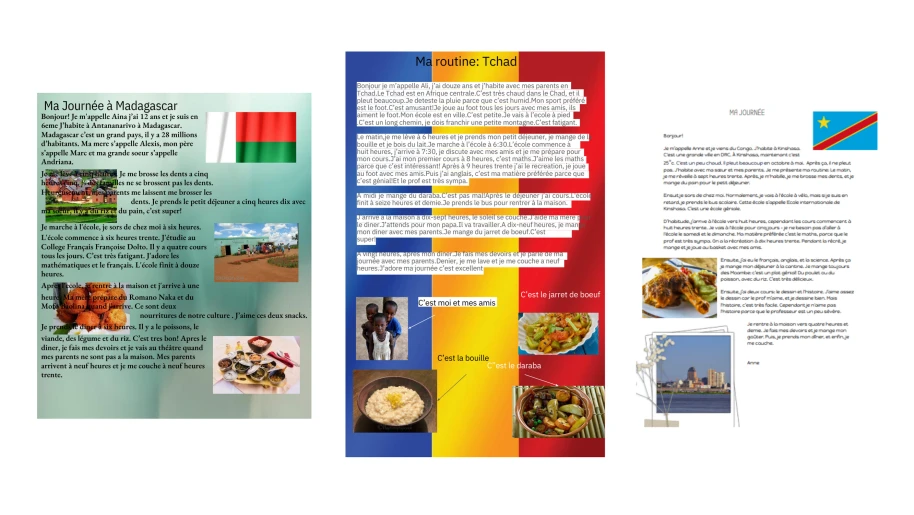
Our end-of-unit project was to be a magazine article where students would research a day in the life of a school student in a francophone African country. We modelled the diary entry on a student in Senegal. The results were fantastic. Students chose a country, researched where they would live, chose a traditional name, looked at the food they would eat, and also focused on differences and similarities between their schooling and that of their chosen location. After introducing the project, we encouraged learner agency by asking students to write their assessment rubric which they did with competency, whilst also challenging themselves to include academic rigour.  

From a traditional approach, our students now experience Knowledge, Skills, and Understanding via an exciting journey in language learning. Textbooks are gone, consistency is across the board in all three languages, reflection is continuous and our department team teaches and collaborates at all times. Assessment is formative and summative with student input. To mention a few examples, end-of-unit projects include presentations, slam poetry, podcasts, vlogs, pitching products, and creating new resources for peers. Learner agency and metacognition are highly present at all times throughout our units.

We are in our 4th year of delivering the IMYC and our curriculum in World Languages for Years 7 to 9 is exciting, challenging, and constantly developing. At the end of Year 9, our students are ready to begin the International General Certificate of Secondary Education (IGCSE) with a solid language foundation and are learning skills that will serve them well through to the International Baccalaureate Diploma Programme (IBDP) and beyond.

Back to news

29 February 2024

Embracing Multilingualism: Self-Discovery Through Poetry

“Our sense of self, and that of others, is continually developing through our different interactions and impacts on how we exist in the world.”

This is the big idea of the International Middle Years Curriculum’s Identity unit. In this unit, students delve into the complexities of identity through the lens of poetry, and an important aspect of it is multilingualism. At United Lisbon International School, a school with over 60 different nationalities, the topic of identity gains even more relevance as cherishing students’ backgrounds becomes key in fostering students’ engagement and interest.

Through the exploration of poems by diverse authors such as Tom Leonard, Moniza Alvi, Grace Nicols and George Ella Lyon, students went on a journey of self-discovery. They learned to see themselves and others through different perspectives, understanding that identity is not static but continually evolving. They reflected on their own identities, considering how their interactions with others shape who they are and how they exist in the world.

One of the most impactful aspects of this unit is the inclusion of bilingual poems. These poems allowed students to explore the unique characteristics of different languages and how they reflect their cultural identity. Why did the authors choose to mix two languages in their poems? What kind of impact did it have on the reader? Why did Tom Leonard write phonetically in a Glaswegian dialect? By considering these questions, students were able to recognize the value of multilingualism and how it can contribute to a richer, more diverse and equitable society.

The culmination of this unit is a video poem created by the students. In this project, students brought together their learning about poetic features, their spoken English, their video-making skills and their awareness of the importance of their mother tongue and cultural background. The video poem is a testament to the student’s growth and understanding, showcasing their ability to express themselves creatively and reflect on their own identities.

Two examples of video poems created by students are shared below:

Click to view Video 1

Click to view Video 2

These video poems are not only a celebration of the students’ creativity but also a reflection of the success of implementing the IMYC curriculum in a multilingual environment. By embracing the complexities of language and identity, students can develop a deeper understanding of themselves and the world around them.

In a nutshell, the Identity unit is a powerful example of how the IMYC curriculum can foster self-discovery and appreciation for diversity. After this unit, nothing was ever the same in my classroom. The unit we did right after this one, Entrepreneurship, was enriched with examples of Ads in many different languages. Students enjoyed explaining different taglines and even attempted to explain expressions and puns in their mother tongue.

As Ofelia Garcia, in her book about Bilingual Education called “Bilingual Education in the 21st Century. A Global Perspective”, wrote: “Bilingual Education in the twenty-first Century must be reimagined and expanded, as it takes its rightful place as a meaningful way to educate all children and language learners in the world today.” Let’s keep cherishing students’ backgrounds and mother tongues!

Read more about our curriculum in bilingual contexts.

Learn more about how to implement the IPC effectively at your school from the very start and how to tailor it to your unique context.

Back to news

28 February 2024

Virtual Drop-In Sessions

Dive into the Curriculum with our Free Virtual Drop-in Sessions (for subscribers only!)

To help you explore and discover the magic of the International Curriculum, we’re pleased to announce a series of FREE virtual drop-in sessions covering all three International Curriculums:

What to expect
  • Interactive sessions: Ask questions, share experiences, and connect with other ICA educators from around the world.
  • Curriculum insights: Gain valuable knowledge from the heads of each curriculum who will guide you through topics you would like to learn more about. If you would like to find out about a specific topic or area of the curriculum, please submit your questions in advance here.
  • Global timing options: Join live sessions at a convenient time for you.
Who should attend
  • ICA Subscribers looking for ideas and teaching strategies that work for others.
  • School leaders interested in learning more about how other schools implement the curriculum.
  • ICA Subscribers who are passionate about sharing what they know about improving learning.
Ready to join the virtual drop-in sessions? Here’s how:
  1. Click one of the links below. These links will take you through to our Professional Development Hub which is a platform to access a range of free and paid courses to support your implementation of the IEYC. If you haven’t already, you will need to sign up. Don’t worry it’s completely free to register.
  2. Once you have filled out your details, a member of our team will approve your registration. Make sure to sign up ahead of the start time of the drop-in session you want to attend!
  3. You will then receive a confirmation email.
  4. If you belong to a subscriber school, you will find access to the Drop-in Sessions on your ‘HOME’ page, which you can access after logging in to the PD Hub.
  5. You can look for the Drop-in Session in the ‘More Courses to Choose From’ search bar, by selecting keywords ‘IEYC’ or ‘Free’, or by clicking the link in the ‘Upcoming Events’ image carousel at the bottom of the page.
Click on the links below to register for the sessions that interest you:
Session Dates and Times

IEYC Drop-in Sessions:

  • Tuesday March 26, 10:00am and 16:00pm UK
  • Tuesday April 25, 10:00am and 16:00pm UK
  • Tuesday May 28, 10:00am and 16:00pm UK
  • Tuesday June 27, 10:00am and 16:00pm UK

IPC Drop-in Sessions:

  • Thursday March 13, 9:00am and 16:30pm UK
  • Thursday May 9, 9:00am and 16:30pm UK

IMYC Drop-in Sessions:

  • Wednesday March 6, 9:00am and 18:00pm UK
  • Wednesday April 10, 9:00am and 18:00pm UK
  • Wednesday May 5, 9:00am and 18:00pm UK
  • Wednesday June 5, 9:00am and 18:00pm UK

Don’t miss this opportunity to connect with a global community of educators!

Enquire now

Find out more about ICA products and services!