Search List show here

Back to news

26 March 2024

World Languages and the Middle Years

When we first introduced the International Middle Years Curriculum (IMYC) at French International School for our future Year 7 cohort, we were going through a phase of online learning in our school. Faced with such a hurdle and no unit plans for World Languages, it was immediately met with ‘the curriculum doesn’t apply to us’ and ‘how can we do this?’ Determined to make it work and to build on the excellent work done at the International Early Years Curriculum (IEYC) and International Primary Curriculum (IPC), we focused on how we could make the curriculum work following the Big Ideas alongside our fellow departments. 

The IMYC World Languages Learning Goals already aligned with our current practice so the question of how we deliver the curriculum was our main issue.

As teachers, we had decided democratically on the Big Ideas so it became a question of how we match topics to cover a thorough curriculum for our learners.

We took all topics traditionally covered in KS3, completely rearranged and adapted them to be able to provide a rigorous curriculum.

We began with the Big Idea of ‘Adaptability’. As a French school, the language is compulsory for all and we have 4 levels of learners in each cohort Standard, Intermediate, Higher, and Advanced. Standard is for beginners, Intermediate and Higher for those who have studied French in Primary School, achieving a level equivalent to traditional Year 8 or 9 students and Advanced is typically for native speakers. At that time, Mandarin was taught at 2 levels; Foreign Language and Second Language. We now also have a First Language Mandarin class. Spanish is beginner-level for all students in Year 7.

As a department, we agreed that the topic of ‘School Life’ would be ideal for everybody and fit well with the Big Idea of Adaptability. New learners of French, Spanish, and Mandarin would Adapt to their new language by covering the basics. Intermediate and Higher groups would study school life as they adapt to secondary school and Advanced would begin an introduction to literature by studying texts such as Le Petit Nicolas using Language Arts Learning Goals.

Introducing International Learning Goals is relatively easy for World Languages. Writing from the experience of having taught the intermediate French group, we began by planning our end-of-unit project.

We wanted students to be empathetic whilst also learning about francophone culture and showing off their grammatical knowledge.

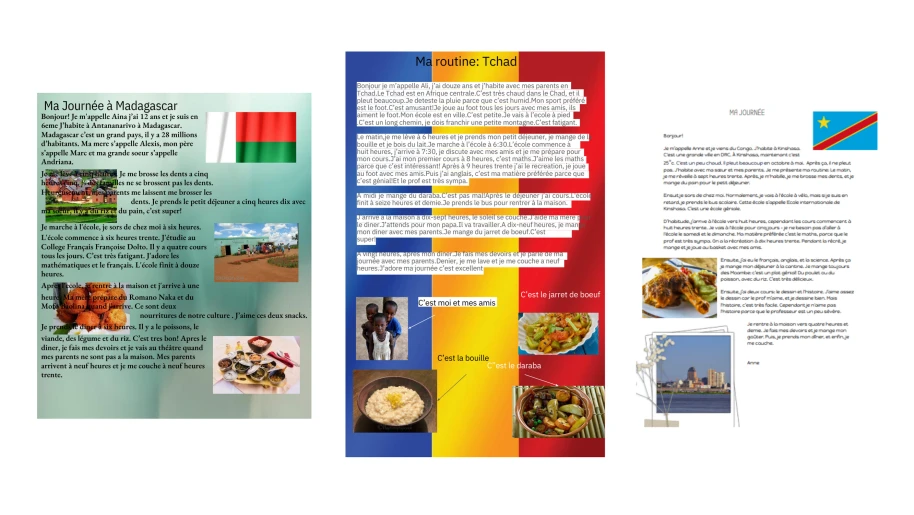
Our end-of-unit project was to be a magazine article where students would research a day in the life of a school student in a francophone African country. We modelled the diary entry on a student in Senegal. The results were fantastic. Students chose a country, researched where they would live, chose a traditional name, looked at the food they would eat, and also focused on differences and similarities between their schooling and that of their chosen location. After introducing the project, we encouraged learner agency by asking students to write their assessment rubric which they did with competency, whilst also challenging themselves to include academic rigour.  
From a traditional approach, our students now experience Knowledge, Skills, and Understanding via an exciting journey in language learning. Textbooks are gone, consistency is across the board in all three languages, reflection is continuous and our department team teaches and collaborates at all times. Assessment is formative and summative with student input. To mention a few examples, end-of-unit projects include presentations, slam poetry, podcasts, vlogs, pitching products, and creating new resources for peers. Learner agency and metacognition are highly present at all times throughout our units.

We are in our 4th year of delivering the IMYC and our curriculum in World Languages for Years 7 to 9 is exciting, challenging, and constantly developing. At the end of Year 9, our students are ready to begin the International General Certificate of Secondary Education (IGCSE) with a solid language foundation and are learning skills that will serve them well through to the International Baccalaureate Diploma Programme (IBDP) and beyond.

Back to news

20 March 2024

Exit Points- A Celebration of Learning

Exit points are the final step in the student’s learning journey during an International Primary Curriculum unit of study. The Exit Point has two main purposes: to help children pull together their learning from the unit and to celebrate the learning that has taken place. At Nadeen, we have had a wonderful start to our IPC learning journey with three extremely successful Exit Points across primary since the introduction of the International Primary Curriculum this year. These have ranged from trips to exhibitions and museums. These celebrations of learning have included parents, teachers, and students from other year groups. 

Students in Year 6 embarked on an enchanting journey about myths and legends from their own country. Students presented their myths and legends through performances, artwork, and storytelling. In Year 5, students created their museum, exploring the theme of “The Great, The Bold, and The Brave.” Transforming their Year 5 and 6 collaborative areas, students showcased artifacts, and interactive displays, and delivered informative tours to year groups in the school. 

“I’m very proud of the Year 5 students. They did independent research prior to the Exit Point and on the day they were able to share their knowledge confidently and with loads of enthusiasm.“ Ms Karlien Year 5 Teacher. “We prepared for the Exit Point by designing things like plates, jewellery, shields, vases and many more things” Hitisha in Year 5 

In Year 4, our students explored the Stone Age, delving into the lives of scavengers and settlers who roamed the earth thousands of years ago. Students immersed themselves in hands-on activities that brought history to life from designing Stone Age paintings to crafting Stone Age necklaces. 

“I enjoyed making Stone Age jewellery and playing interactive games with my mum” Minahil in Year 4.

“It was great to see the children teaching the parents what they had learned in the Stone Age IPC topic. The children showed great enthusiasm showing the parents what life was like thousands of years ago and demonstrated good knowledge of the unit. Parents enjoyed joining the children for a quiz at the end of the exit point to test their Stone Age knowledge. ” Ms Nicole Year 4 Teacher.

In Year 3’s Mummification Exit Point, students engaged in a hands-on exploration of ancient Egyptian culture. They learned about the mummification process, wrote hieroglyphics, sketched ancient designs, and constructed miniature pyramids. This immersive experience deepened their understanding of ancient civilizations and fostered creativity.

In Year 2, our students completed an observational walk to our local mall of Dilmunia, where they found inspiration in their surroundings. Through observational drawing, students captured the beauty of some of the local buildings and created stunning artworks that reflected their observations and experiences while also enjoying a picnic.


“On our way back to school, the buzz of conversations among students and parents about the day’s experiences was heartwarming. Their drawings, each unique and insightful, reflected their keen observations and what they had learned about Art.“ Mr Joseph Year 2 Teacher.

“For our Exit Point, we went on a walking trip to Dilmunia Mall to sketch Dilmunia Mall, the canal or Nadeen School. The walk from school was exciting, we walked in pairs and enjoyed looking around the street.” Shanzey Jahanzeb in Year 2

Year 1 explored the world of buildings and studied various structures in towns and cities globally, drawing inspiration from projects from our local surroundings. Additionally, students explored the concept of recycled buildings, broadening their understanding of sustainability. 

Exit Points offer parents a firsthand glimpse into their children’s learning experiences and achievements. By attending exhibitions, performances, and presentations, parents gain insight into the curriculum and see how their children are applying their knowledge and skills in creative and meaningful ways. Exit Points is a celebration of learning that enriches the educational journey of our students while strengthening the bonds between our school and the wider community.

Back to news

13 March 2024

A Teacher’s Journey with ChatGPT and Beyond

Over the past 4 decades, I have seen some remarkable shifts in the resources available to teachers.  Recently a new tool has arrived with great potential to enhance the lives of teachers and students alike, if not revolutionise education itself – artificial intelligence.

As an early adopter of ChatGPT at the beginning of 2023, I was quickly impressed by some of its education-related capabilities. It was able to provide levelled-texts on demand on any subjects I could think of.  It could also create a variety of receptive and productive tasks for students for those same texts that focused on specific chosen aspects of learning. It could help redesign a lesson to increase student engagement, suggesting ideas for variety and dynamism. It could simplify existing planned tasks providing opportunities for differentiation. It could redesign a lesson while still adhering to the stated Learning Goals. And a lot more.

How ChatGPT Became a Game-Changer in My Classroom

Being the Academic Director at Tonkla School Chiang Mai, I quickly saw the potential for it to help both experienced teachers and newer teachers by providing ideas for planning, teaching, and assessment. I am trying to encourage differentiation across all grade levels and I found that ChatGPT could play a complementary role in teacher development by suggesting various approaches to modifying content, tasks, instructions, and seating, for example, that follow up on or prepare for face-to-face PD sessions. I have held several PD meetings with IPC and English teachers to explore the potential benefits, always headlining with the reminder that human oversight is essential every time it is used. It can quite confidently make mistakes and needs correcting at times. While a few staff members seemed almost suspicious of it, as if I had just shown them a conjuring trick, many teachers have embraced it and recognised the positive impact it can have on their planning and teaching.

New websites and applications making use of this technology have been appearing almost weekly, offering help with everything from curriculum planning and assessment, to slide creation from a video, and interviewing famous people from the past about their lives. Towards the end of 2023, OpenAI, the makers of ChatGPT, launched a significant upgrade, only currently available to subscribers, that not only allowed GPT to search the internet in real-time but also to produce high-quality custom images, all from one prompt box. But perhaps the most valuable aid for teachers was the introduction of custom-made GPT bots.

The Rise of Custom-Made GPT Bots: Putting AI Expertise at Every Teacher’s Fingertips

This new feature allows anybody to custom design a bot, or AI assistant, in a few minutes for any purpose that they need, without any technical know-how. You simply need to type what you want in clearly labelled boxes. So, what does that mean? One of the first things I made was an IPC Learning Navigator bot for Primary 1 teachers who were using the ‘A Day in the Life’ unit. To save a lot of time writing long prompts in regular ChatGPT, I simply instructed the bot with the teaching context – age and level of students – and what I wanted it to do – help with all aspects of lesson planning, teaching, and assessment – in the instructions box. I then uploaded the ‘A Day in the Life’ unit to the bot’s knowledge base. An important step here is to uncheck the box that says ‘Use conversation data in your GPT to improve our models’. This ensures the protection of copyrighted material. Uploading files to the knowledge base means that whatever you ask, it will first go straight to that uploaded file and search. The teacher now has an IPC expert planning assistant specifically for that unit. An example of some prompts I gave it were: ‘Simplify History task 2’, ‘How can I integrate Music learning goals more fully in my lessons?’, ‘Provide five level-appropriate video clips, with links, that relate to Geography task 1’. The latter prompt sent it to the internet to search websites for suitable clips with links that took you directly to the sites. In theory, every teacher could have one of these ‘teaching assistants’ at hand to use whenever needed for each unit they were using. These bots do not have to be IPC specific but can offer more generic help with planning and teaching including bots that are designed to help teachers teach students with ADHD, dyslexia, and autism, for example.

Beyond ChatGPT: Exploring the Future of AI in Education

As a primary school, we can focus on the benefits to students via the teachers’ use. The challenges of students using AI in their course work is a warmly discussed topic on many AI educator forums and undoubtedly in many staffrooms around the world and that subject is best kept for another post. One aspect that holds great potential is the idea of AI tutor assistants. These are bots that can be embedded into learning websites (Khanmigo with Khan Academy Kids, for example) or used independently by students, and rather than give answers, they are trained to guide the students on how to solve problems in whatever subject they are focusing on.

Being a proponent of teachers exploring the benefits of AI, I am acutely aware of other voices that speak against its use. There are certainly conversations to be had, standards to be set, and policies to be formulated. However, I believe that things are only going to accelerate in this area in the coming years and as educators, we should, at the very least, educate ourselves about the use of these new tools so we can adapt effectively.

International Primary Curriculum

Back to news

12 March 2024

LIVE WEBINAR AND PANEL DISCUSSION – Growing and Greening a Sustainable School Culture, Curriculum and Community

We invite you to join us on March 27th at 13:00 GMT for an enlightening webinar as we delve into integrating sustainability into your school culture, curriculum and community, and navigating the 17 Sustainable Development Goals (SDGs).

Learn From Other Schools Around the World

Discover how some schools in different parts of the world are aligning their educational frameworks with the United Nations’ 17 Sustainable Development Goals (SDGs). From fostering global citizenship to addressing environmental challenges, our panellists will share the transformative power of weaving sustainability into the fabric of education. There will be engaging discussions, sharing of practical strategies and inspiring anecdotes for educators seeking to empower the next generation with the knowledge and skills needed to tackle real-world issues.

Our panel includes:

BROUGHT TO YOU BY

The ICA Outreach & Development Team

This webinar series is brought to you by the ICA International Outreach and Development Team. Their aim is to inform schools around the world about the benefits of the International Curriculum and support them through the initial stages of their journey with implementation.

The link will take you through to our Professional Development Hub which is a platform to access a range of free and paid courses. You will need to sign up to access the webinar. Don’t worry it’s completely free to register!

Back to news

7 March 2024

Enhancing Mindset, Improving Learning: The impactful journey with ICA

We are so grateful to receive the news that our school, Sekolah Cita Buana, was presented with the Recognition Award from the International Curriculum Association (ICA). It was an accomplishment for the whole school community:  the academic team, parents, students, staff, and the school management team who took part from day one when we decided to have the implemented International Early Years Curriculum (IEYC) reviewed by the ICA through its recognition process.

Reviewing the curriculum implementation that has been the heart of the school’s learning process for more than five years and the commitment to provide quality education for the community were two of the management’s genuine intentions to have the ICA recognition process. Those goals were crucial, especially since the school had just experienced a significant impact from the pandemic that struck the country hard. The uncertainty and chaotic situations made the school often change its learning policy. Internally, our school also lost several faculty members; five people died of COVID-19, some were in isolation, and many needed logistic supplies. The anxiety rose when many schools in the region closed down because of some unfortunate conditions.

When many schools in Jakarta were at such a loss, having IEYC as our learning guidance was more than a blessing to us in that time full of challenges. The IEYC Learning Foundations and Coverage align with our school’s unique educational service and culture, with its inclusivity, where children of different abilities and needs are valued. The Personal Learning Dimensions were indeed a lifesaver. Children’s resilience and adaptability were put into solid practice from 2020 to 2023. The teachers conducted different scenarios of learning and explorations, ensuring the learning provided meaningful experiences for the children online or blended and onsite with some restrictions. The definition of learning had naturally transformed into physical and mental well-being for all.

Sekolah Cita Buana in Jakarta is a joint-cooperative school that also implements the National Curriculum (Kurikulum Merdeka), not merely to fulfill the government regulation but also since its establishment in 1995, the spirit of nationalism is explicitly stated in the school’s vision, mission, and educational goals. The International Goals of the IEYC equip the children in our school to develop their curious mind and sense of curiosity about the world and its people. Children are also allowed to explore global perspectives, and when ready, they can take action and make a difference. We believe that this combination is what made our school keep its existence.

Some consolidations are needed to recover the learning and patch the development gaps among the children. The ICA Recognition Process has helped to measure the effectiveness of the curriculum implementation in our school. We felt guided and encouraged to continue confirming the understanding of the curriculum implementation and improving the learning for our young learners. The mentoring sessions provided clarity about the required evidence. As our school also met the standard of Indonesia’s MoE, we almost did not find major difficulties in the journey of the ICA Recognition Process. The required documents did support the requirements set by ICA. The only challenge was our internal time management, and we appreciate the patience and commitment of the mentor and accessor from the ICA, which kept us going to achieve our goal.

With the ICA Recognition Award we received, we are more confident in the continued improvement and curriculum implementation. Also, with the quality assurance by the ICA, Sekolah Cita Buana can provide the most valid document required by the government for national accreditation and school permits. But, again, above all, providing quality education that gives true impact to the learners and an enhanced mindset to the school community are the main intentions of the journey we took with ICA.

Recognition and Accreditation

Sign up to receive the icaVoice newsletter on our home page!

Back to news

7 March 2024

Inspiring Education: A Conversation with Colin Gear

Q1. Can we start with a glimpse into your professional journey? Can you share a bit about your background and how you found your way to the ICA?

After completing my NQT year in Scotland, I was very fortunate to secure a position at the International School of Koje in South Korea (now Atherton International School). The school had just started to embed the International Curriculum in the year before I joined the team, and were already on their initial accreditation journey for both IPC and IMYC. This allowed me to get into the self-review reflective mindset almost immediately, going through ICA training courses to give myself better insight into how to get the most from my lessons. During the training courses, I read a lot about the needs of the adolescent brain and this part of the curriculum fascinated me because it helped me to understand why the International Curriculum is structured in the way it is and how this helps the developing brain.

In 2018, I became the IMYC Coordinator at ISK and this role allowed me to dig deeper into the collaborative approach of the curriculum, helping to support teachers to build and connect between each other’s subjects, and stressing the importance of supporting the developing brain. It was while in this role that I saw the potential of the International Curriculum and the impact it had on our school’s learners. The engagement and interest that was happening across all subjects allowed our learners to dig deeper into subjects due to a breeding of a culture of curiosity and support. 

This role led to me becoming a trainer for the ICA, a role that I still thoroughly enjoy to this day, as it allows me to support new schools in their journey with the International Curriculum and share my own experiences of its implementation. 

I joined Hope International Academy Okinawa in July of 2021 in the role of Curriculum Coordinator, and in this capacity, I have supported both IPC and IMYC teachers in their journeys with the implementation of the International Curriculum. My role’s main focus is to support the school’s self-review goals, including organizing and supporting Hope’s ICA Recognition and Accreditation visits in May 2022 and November 2023 respectively. I have been lucky to work with an excellent team at the school who have a real passion for developing our learners and celebrating their growth. 

Q2. In every journey there are challenges. Can you share with us some of the obstacles you have faced and how they might have shaped your professional growth?

I think the biggest obstacle in my initial years with the International Curriculum was finding the right systems and structures to put in place to ensure that Exit Point projects were meaningful, with learners being supported in the creation of these projects. Reflecting on how best to develop media skills, presentation skills, and how to probe learners to demonstrate a deeper understanding of their IMYC Big Ideas, also allowed me to get a deeper understanding of the value of Exit Points in the Middle Years space. Through over a year of reflection and collaborative discussion, I learned the importance of giving time to allow the learners to build up those all-important media skills, with appropriate feedback and support, and how to build this skill into conveying an overarching understanding of a Big Idea. 

Another big challenge, particularly in the Middle Years space where often there are different subject specialist teachers for all subjects, was ensuring that all important collaboration and consistent messaging for IMYC learners. One of my big lessons here was ensuring that time was provided for this collaboration, as the benefits became clear almost immediately in terms of getting more meaningful conversation for planning Entry Points, as well as giving teachers insights into each other’s subject lens, and how they can build this into their lessons. 

Overall, I think these challenges helped me to better understand what I am doing as a teacher, why I am doing it, and how I can support others who are also going through this process. The more everyone has a common understanding of the purpose of the structures like the Process to Facilitate Learning, and why it is designed in the way it is to support the brain, the more every teacher can get out of their lesson. The more teachers are aware of what is happening in other subjects, the more opportunity there is to build those key connections to the Big Idea. Time to ensure this can happen is essential, and by giving time and space for these collaborative discussions, a deeper style of learning can be achieved. 

This has driven all of my professional growth into a consistent reflective practice of how to get the best out of the International Curriculum. 

Q3. We’d love to know a bit more about you beyond your professional persona. What do you like to do when you’re not working?

I’m a big fan of professional wrestling! I’m lucky to currently live in Japan, where there is a rather big wrestling industry, with lots of local and national companies. This has allowed me to attend a lot of live shows over the last few years, either with companies coming to do shows in Okinawa, or traveling to Tokyo or Osaka to see bigger shows. Every year on the 4th of January, one of Japan’s biggest companies does a show at the Tokyo Dome. When travelling to go and see shows, it’s also a fun opportunity to explore new cities, I love to walk around and explore and even though I’ve been to cities like Tokyo or Osaka a lot, it always feels like there are new experiences and more to see. 

Q4. Looking ahead, what’s your vision for the future of international education and the role of the ICA?

We continue to learn more about how the brain works all the time, and how we can best support the challenges faced by ICA learners. As we further gain insight into how the research will impact teaching and learning, I feel that m

One of the big standouts to me in recent education conversations I’ve been involved with is a cultural shift in the mindset of how we view student achievement, moving away from year-group-based grading structures and instead putting the focus on the journey of the learner. Particularly in the sphere of international education, age-based expectations can vary from country to country, curriculum to curriculum and when schools have a range of learner backgrounds, insight into student’s growth feels like the most valuable information you can gain to support future planning, as well as school structures.  By celebrating the progress a learner has made from where they began, and highlighting the journey of growth they have gone through, more productive conversations can be had between learners, teachers, leaders, and the community. 

This is why I value the ICA thinking as the structure of assessment for the International Curriculum provides the opportunity to get conversations based around learner success and areas for development in a practical way that better informs the outside community of what each learner has truly achieved. The Assessment for Learning Toolkit, as well as resources like the Report Guide from the ICA support in getting this message across to the wider community. 

Q5. Morning person or night owl?

I think most people who have run into me first thing in the morning at work know that I probably lean more towards the night owl!

Q6. Coffee or tea…or?

When I started teaching, I was still a big tea drinker, but to support my lack of “morning person” skills, coffee has certainly been the go-to tool recently.

Q7. Dream travel destination?

I’m currently living in it, it was always a goal of mine to spend time in Japan, particularly given my hobby of watching professional wrestling, and I’m still exploring more of Japan all the time. 

Q8. Favourite type of cuisine?

Either Korean BBQ or Steak Sushi.

Q9. One thing on your bucket list?

I’m a big fan of rollercoasters and my friends in the USA have suggested a few theme parks that have a range of great rides. A tour through some of these parks and meeting my friends in these areas would be a great experience, I think. It’s also an opportunity to explore America, which I’ve never done. 

Q10. A recent book that you have read?

“Parsnips, Buttered” by Joe Lycett

Sign up to receive the icaVoice newsletter on our home page!

Back to news

7 March 2024

Inspiring Education: A Conversation with Catherine Copeland

Q1. Can we start with a glimpse into your professional journey? Can you share a bit about your background and how you found your way to the ICA?

I hail from Canada, where I began my teaching journey in 1990 as a primary school teacher, teaching French, music, art, geography, and choir. I taught at both public and private schools in Ontario. My international education career started after I took my Master’s degree in Educational Science in Amsterdam in my early thirties, when I moved to the south of the Netherlands, to a city called Maastricht. There, I took a role leading a Dutch International Primary School in the transition to a new United World College. This was from 2005-2013. The IPC was a key factor in the professionalisation and growth of the new school which was doubling in size during the 8 years that I worked there. I was fortunate enough to work with Martin Skelton, a founder of the IPC,  who visited my school for professional development and also provided guidance for the development of the new UWC. He also led the Leader of Learning course in Greenwich, UK which I participated in one summer and where I helped to develop the ‘Looking for Learning Assessment Toolkit’. 

During those years, I studied at the doctoral level at Bath University where the leaders of the Education Department were big supporters and involved with the development of the IPC and IMYC.  That led to co-authoring a chapter in the book “Taking the IPC Forward” describing how the IPC supported and created the DNA of the school. My next move took me to southern Spain where I was a founding head of a small private school that implemented the IPC. In 2019, I moved to China where I worked in a large, private, IB World School school in Beijing, which when opening implemented the IPC in its primary division. Over the last decade, I have enjoyed doing conference presentations, webinars, and training teams implementing the IPC. More recently, I have been mentoring schools and working as an accreditation team member, which I am thoroughly enjoying!

Q2. In every journey there are challenges. Can you share with us some of the obstacles you have faced and how they might have shaped your professional growth?

I think the obstacles that I often faced and that troubled me were related to mindsets- closed mindsets more precisely. I became impassioned about international education and global education at a time when Europe was transforming with the signing of the Maastricht Treaty. I became committed to wanting to change the perspectives of educators and communities towards ideals of global education, essentially becoming a changemaker and empowering others to become changemakers.

The work that I did in Maastricht really helped me learn how to navigate in a complex, hybrid, multinational environment and it’s where I learned the power of a strong mission and vision to lead school communities- and this still resonates with my accreditation work with the ICA today. Equally, developing service learning and global competencies was work that was in pioneering stages back then and I learned a lot when developing my mindset in tandem with the IPC Fieldwork and now the ICA. 

Q3. We’d love to know a bit more about you beyond your professional persona. What do you like to do when you’re not working?

Admittedly, I am a bit of a workaholic because I love what I do! When I am not working, I am often traveling, reading, cooking, writing, or researching. I enjoy forest walks and being at the lake when in Canada and beach walks and tapas when in Spain (I have been living between those two countries lately). I also love to be in the mountains or beside water. I am interested in art, antiques, galleries, museums, and gardens.

Q4. Looking ahead, what’s your vision for the future of international education and the role of the ICA?

On top of the excellent curricula developments, I am excited to see the ICA develop in areas of professional growth and accreditation, becoming an integral support to schools and educators worldwide. It’s amazing to experience how schools all over the world thrive when implementing the ICA curricula and I would love the ICA to have an even bigger impact in the field of global education. I have always felt that we need to move from international education to global education because it’s not just relevant for international schools- all students would benefit from developing international-mindedness and global competencies. I would also love to see the ICA become leaders in sustainability and greening schools and supporting climate action education in ICA services. 

Q5. Morning person or night owl? 

Night owl

Q6. Coffee or tea?

Coffee – Espresso Lattes in the morning – then green tea in the afternoon

Q7.Dream travel destination? 

Argentina

Q8.Favourite type of cuisine?

French

Q9.One thing on your bucket list?

See the cherry blossoms in Japan

Q10.A recent book that you have read?

Lifespan- Why We Age- and Why We Don’t Have To – David Sinclair, PhD (Harvard geneticist)

Sign up to receive the icaVoice newsletter on our home page!

Back to news

7 March 2024

Unpacking the International Curriculum Conference 2023: A Summary of the Inspiring Insights

I had the privilege of attending the International Curriculum Conference for 2023 (ICC23) in Ho Chi Minh City, organized by the International Curriculum Association. Despite the long journey from Zambia to Vietnam, the enriching experience made every mile worthwhile.

The conference united educators from around the globe, fostering a collaborative environment that encouraged the sharing of educational journeys. Informal networking sessions allowed for insightful discussions, motivating me to enhance my teaching practices. It was a platform where curriculum leaders, including myself, exchanged ideas and explored ways to optimize learning using ICA programs.

The keynote on Global Competency resonated with me, energizing my commitment to initiate projects at the International School of Lusaka. Additionally, leading a session on Learner Agency in the IMYC provided an opportunity to share insights and deepen my understanding of the topic.

The exceptional support from ICA staff during session preparation and execution was instrumental. Their encouragement empowers educators to share their expertise confidently. I was honored to contribute to a keynote alongside inspiring colleagues, thanks to the thoughtful session led by Sarah and the team.

Bringing home a wealth of knowledge, I am already sharing insights with my colleagues at the International School of Lusaka, where I’ve been teaching for thirteen years. Leading the IMYC for seven years, the conference has sparked fresh ideas to enhance learning experiences at ISL.

Celebrating sixty years of existence, ISL offers a diverse international education, embracing IB PYP, IMYC, IGCSE, and IB DP programs. With students and teachers from over 60 countries, ISL creates a rich intercultural learning environment. The school’s commitment to developing globally competent students aligns seamlessly with the philosophy of the ICA.

In conclusion, the ICC23 was a transformative experience, fostering collaboration and innovation in education. I am excited about the positive impact these insights will have on the learning journey at the International School of Lusaka.

Sign up to receive the icaVoice newsletter on our home page!

Enquire now

Find out more about ICA products and services!